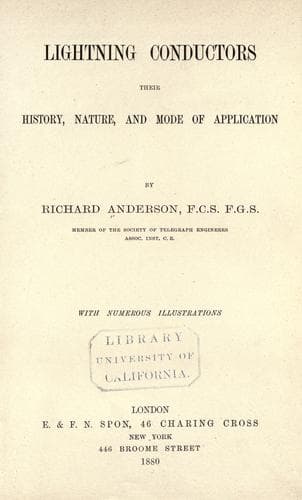
Lightning Conductors: Their History, Nature, and Mode of ApplicationAnderson, Richard, F.C.S.
History
Lightning Conductors: Their History, Nature, and Mode of Application
Anderson, Richard, F.C.S.
Lightning conductors
With the exception of the terminal rod, it is the rule in France to
cover the whole of the paratonnerre with some coating in order to
preserve it from contact with the air. This is attained by covering it
with either a strong coat of tar, or a painting of a metallic basis,
such as zinc or tin filings.
[Illustration: Fig. 15.]
In larger buildings what is termed a ‘ridge-circuit’ is often used. It
consists of an unbroken metallic connection running along the ridges
of the building to be protected, and connected with the conductors
and terminal rods, and consequently with the subterraneous sheet of
water which forms the common reservoir. It is made of lengths of
square iron bars or rods having a thickness of about three quarters
of an inch square, and fastened together by overlaying the ends,
bolting them together with two bolts, and covering them well with
solder in the manner shown in fig. 13. New branches are formed by
T-shaped connections, the cross-piece of the T overlaying the original
ridge-circuit, and the stem making the first length of the new branch.
In some cases the ridge-circuit rests directly on the ridge of the
roof; but in order to avoid injury during the repairs to the roof or in
other ways, the plan adopted in good work is to raise it some distance
above the ridge on supports at suitable distances, and thus prevent the
possibility of damaging the joints and solderings.
The form and arrangement of these supports depend on the nature of the
roof. Sometimes forked uprights are used--these allow for the expansion
and contraction due to changes of temperature; in other cases simple
cast-iron bearings, weighing from ten to twelve pounds each, are laid
upon the ridge, their upper surfaces being grooved to receive the bars
of the ridge-circuit.
All masses of metal used in the construction of the building are
metallically connected with the paratonnerre. As a rule, this is
done by pieces of iron about half an inch square, which are strongly
soldered to the metal surfaces, and then connected with some part of
the conductor or ridge-circuit.
Although in France, as elsewhere, all experts are agreed as to the
prime importance of the disposition and arrangement of the _racine_ or
earth-end of the paratonnerre, a difference of opinion prevails as to
the best means of insuring a good earth-contact, and many methods have
been tried, all of them similar in principle, but differing somewhat in
application. It is proposed to give here a brief outline of the best
contrivances employed for this purpose.
Public-domain text, read in full here on John Shaqi.
Reviews
Reviews
No reviews yet
Be the first to share your thoughts on this work.
Elsewhere in the archive
Join the Discussion
Join the discussion
Sign in to leave a comment or review.
Sign InorCreate an account