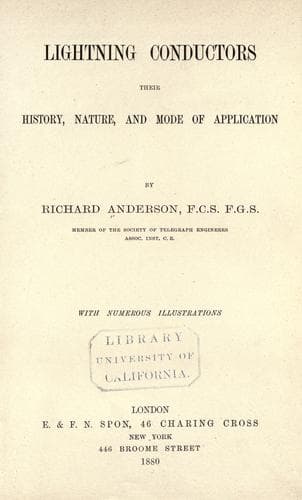
Lightning Conductors: Their History, Nature, and Mode of ApplicationAnderson, Richard, F.C.S.
History
Lightning Conductors: Their History, Nature, and Mode of Application
Anderson, Richard, F.C.S.
Lightning conductors
The magazine was an oblong building of brick, nine feet long, five feet
wide, and six feet high (internal dimensions), and it had a uniform
thickness of three bricks. At one end was a heavy iron door, and at
the other a lightning conductor, consisting of a copper-wire rope
seven-sixteenths of an inch in diameter. The point of the terminal rod
was about thirteen feet above the top of the building, and a similar
length was carried into the ground and terminated in clayey soil. The
conductor was fixed to a pole distant about two inches from the end of
the building opposite to that in which the iron door was fixed. _It
was not connected with the iron door in any way._ At the time of the
explosion the magazine contained about 2,000 pounds of gunpowder.
Major Majendie, H.M.’s Chief Inspector of Explosives, in his official
report ascribed the accident to the fact of the iron door being
unconnected with the lightning conductor, and in doing this he was
doubtless right, but only to a limited extent. The author of this work
visited the colliery shortly after the explosion, and found that the
conductor--the weight of which was about one pound per yard--had been
fastened to the pole, which was about twenty-one feet high, by two
glass insulators, and that the conductor was not connected with the
building. On testing the copper rope which formed the conductor, its
conductivity was found to be only 39·2 instead of 93 or 94 per cent.
The conductor, therefore, was but little better than if it had been
made of iron, and, even supposing it had been made of good copper, it
was of too small a size. It should have been of double the weight, and
_not_ insulated from the pole. In order to be thoroughly efficient it
ought to have been brought down the pole, carried through under the
roof, down the iron doorpost, and so into the ground.
According to the French theory, that the ‘area of protection’ afforded
by a lightning conductor is the space contained within the circular
area of a radius double the height of the conductor, the magazine was
thoroughly secured, for the conductor was twenty-one feet high, and the
building only nine feet long, five feet broad, and six feet high. This
case, however, with many others, entirely controverts this theory, and
shows very forcibly the fallacy of an argument that at one time was
accepted almost as an axiom.
Public-domain text, read in full here on John Shaqi.
Reviews
Reviews
No reviews yet
Be the first to share your thoughts on this work.
Elsewhere in the archive
Join the Discussion
Join the discussion
Sign in to leave a comment or review.
Sign InorCreate an account