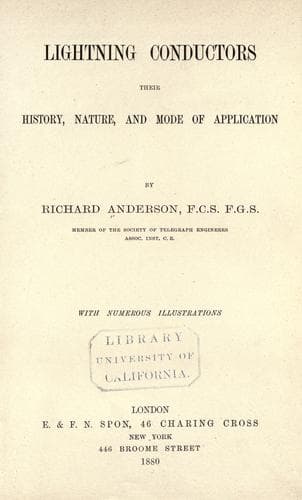
Lightning Conductors: Their History, Nature, and Mode of ApplicationAnderson, Richard, F.C.S.
History
Lightning Conductors: Their History, Nature, and Mode of Application
Anderson, Richard, F.C.S.
Lightning conductors
The data given here is necessarily incomplete, although much trouble
has been taken in obtaining it. Many countries keep no separate records
of deaths and accidents from lightning, and those kept by others
are often meagre and untrustworthy. Still the statistics given are
sufficient to prove that lightning constitutes no unimportant factor
among the dangers that threaten the safety of human life. The apathy
with which the danger is regarded by most people is simply astounding:
very few make any effort to protect themselves or their houses
against it, although during certain months of the year it is almost
impossible to take up a newspaper that does not contain an account
of some fatality or casualty from the effects of a thunderstorm. The
long roll of accidents appended to this chapter shows only too clearly
the enormous amount of damage that has arisen--and is continually
arising--from this source. Public buildings fare little better than
private houses. Even some of the first cathedrals of England have no
lightning conductors whatever, while others, supplied with them, are
insufficiently protected, as is apparent to any competent observer. A
glaring instance of the absence of protection against lightning is to
be found at Windsor Castle. It is a fact that several portions of this
splendid palace, among them St. George’s chapel, and the adjoining
Belfry Tower, are entirely unprovided with lightning conductors. On
other parts of the castle a few conductors are placed, but clearly
not enough. It is needless to say that, speaking only of St. George’s
chapel and the Belfry Tower, these beautiful buildings, constantly
touched by the storm-clouds that sweep up the valley of the Thames, are
liable at any moment to destruction or great damage.
Thomas Fuller, in his ‘Church History of Britain,’ states that--
‘There was scarce a great abbey in England which (once, at the least)
was not burnt down with lightning from Heaven. 1. The Monastery of
Canterbury, burnt anno 1145, and afterwards again burnt anno 1174. 2.
The abbey of Croyland, twice burnt. 3. The Abbey of Peterboro, twice
set on fire. 4. The Abbey of Mary’s in York, burnt. 5. The Abbey of
Norwich, burnt. 6. The Abbey of St. Edmondsbury, burnt and destroyed.
7. The Abbey of Worcester, burnt. 8. The Abbey of Gloucester. 9. The
Abbey of Chichester, burnt. 10. The Abbey of Glastonbury, burnt. 11.
The Abbey of St. Mary in Southwark, burnt. 12. The Church of the Abbey
of Beverley, burnt. 13. The steeple of the Abbey of Evesham, burnt.’
Public-domain text, read in full here on John Shaqi.
Reviews
Reviews
No reviews yet
Be the first to share your thoughts on this work.
Elsewhere in the archive
Join the Discussion
Join the discussion
Sign in to leave a comment or review.
Sign InorCreate an account