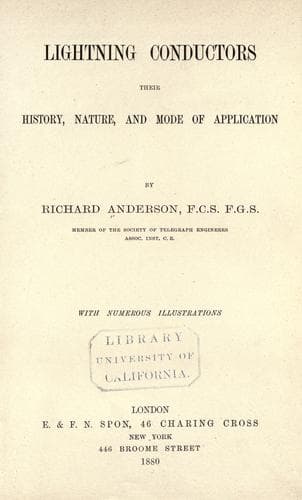
Lightning Conductors: Their History, Nature, and Mode of ApplicationAnderson, Richard, F.C.S.
History
Lightning Conductors: Their History, Nature, and Mode of Application
Anderson, Richard, F.C.S.
Lightning conductors
After minute examination, it was evident that the course of the
lightning had been nearly as follows:—‘The flash first struck the
gilded vane, marks of lightning being perceptible between its bevelled
edges. After traversing the vane and spindle, and the terminating iron
supports, the only path left for the fluid was through a series of
iron cramps, separated by masses of sandstone; and here it was that
the explosion commenced--the stone being torn and hurled aside as it
came in the path of the lightning to the lowest lead lights of the
spire. Most of these iron cramps were found to be powerfully magnetic;
and one of them, eight weeks afterwards, sustained a very considerable
brush of steel filings at its edges. The lattices of the lights on
three sides of the spire were little injured; but on the fourth side
the stone-work was shattered, and the lattice singularly twisted and
partially fused. Here, it appears, another violent explosion took
place, and the lightning diverging struck the north-west pinnacle,
attracted apparently by the copper bolt by which the stones were held
together. It also struck the large cast-iron pipe on the other side
of the spire, reaching from the tower-battlements to the roof of the
church; and during its passage down the pipe, and at an inequality in
the surface of the metal, it displayed the most extraordinary expansive
force, bursting open and scattering to a distance portions of metal of
great solidity and weight. From the leadwork of the roof the lightning
was conducted to the leaden gutters, and so finally to the earth.
‘The course of the remaining current in the interior of the tower
was first to be traced on the lattices of the belfry, then in the
clock-room, where the works of the clock were strongly magnetised,
thence in at least three different directions to the outside of the
tower. The external faces of the clock were not much altered, the hands
were, however, slightly discoloured, and the blackened surfaces of
the dials covered with streaks, as if smeared with a painter’s brush.
On quitting the dial faces on the northern and southern sides of the
tower, the lightning evidently fell upon the leads of the side lobbies,
and was finally carried off by the two iron pipes connecting their
roofs with the earth. Both these pipes were chipped and injured, and
one of them was perforated, as if by a musket-shot, a few inches from
the ground. The edges of this fracture were found to possess magnetic
power. Thus, besides the division of the current at the upper part of
the spire, there was a second division in at least three directions
from the clock-room and dial faces. The roof of the church throughout
its whole extent showed signs of an extraordinary diffusion of the
electric current; and in almost every place where one piece of metal
overlapped another, a powerful explosion had evidently taken place.’
Public-domain text, read in full here on John Shaqi.
Reviews
Reviews
No reviews yet
Be the first to share your thoughts on this work.
Elsewhere in the archive
Join the Discussion
Join the discussion
Sign in to leave a comment or review.
Sign InorCreate an account