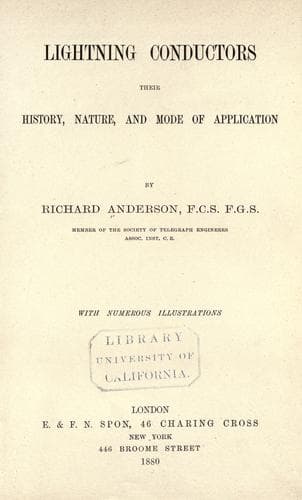
Lightning Conductors: Their History, Nature, and Mode of ApplicationAnderson, Richard, F.C.S.
History
Lightning Conductors: Their History, Nature, and Mode of Application
Anderson, Richard, F.C.S.
Lightning conductors
From out of the almost endless number of cases in which lightning
conductors failed for want of a good earth connection, another one or
two may be given, illustrated as having happened quite recently in
England, and as such showing, in a very striking manner, in what a
neglected state the knowledge of the subject still is at this moment.
A thunderstorm passed over the town of Clevedon, Somersetshire, in the
afternoon of March 15, 1876, and a flash of lightning fell upon the
steeple of Christchurch, provided, as was generally thought, with a
most efficient conductor of recent construction, made of good copper
rope. What happened is graphically and minutely told in a letter
addressed to the ‘Journal of the Society of Telegraph Engineers,’ by
Mr. Eustace Buttor, of Lewesfell, near Clevedon. ‘There was but a
single flash,’ Mr. Buttor relates, ‘which appeared to many observers
to travel horizontally through the air. However, the lightning passed
down the lightning conductor of Christchurch. The flag-staff, about
100 feet high, and the four pinnacles, about 90 feet high, have each a
conductor, the flag-staff having the usual conical point, the pinnacles
having the copper rope attached to their vanes. The five copper ropes
unite inside the tower in the neighbourhood of the clock. Lower down
the conductor passes through a slanting hole to the outside, and for
the lowest 12 feet is encased in a pipe. On reaching the ground it
passes into a dry freestone channel for about a dozen feet, and then
dips down into the drain which carries rain-water from the roof. As no
rain preceded or accompanied the flash, it may be presumed that _the
drain was dry_.
Public-domain text, read in full here on John Shaqi.
Reviews
Reviews
No reviews yet
Be the first to share your thoughts on this work.
Elsewhere in the archive
Join the Discussion
Join the discussion
Sign in to leave a comment or review.
Sign InorCreate an account