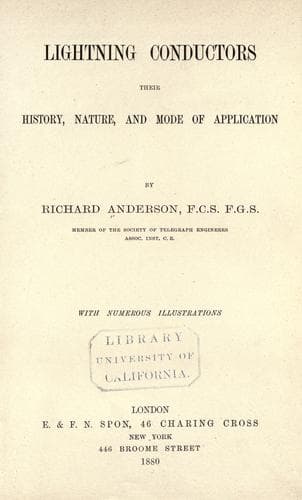
Lightning Conductors: Their History, Nature, and Mode of ApplicationAnderson, Richard, F.C.S.
History
Lightning Conductors: Their History, Nature, and Mode of Application
Anderson, Richard, F.C.S.
Lightning conductors
There is a third ground, as material for consideration as each of the
two preceding ones, upon which the regular inspection of lightning
conductors must be strongly urged. It is, that constant alterations
in the interior of buildings, private residences as well as public
edifices, may serve to destroy the efficacy of a conductor which was
originally good, even to perfection. Thus a roof may be repaired, and
lead or iron introduced where it was not before; or clamps of iron may
be inserted in the walls of houses, to give them greater strength;
or, in fact, any changes may be made which bring masses of metal more
or less in proximity to the conductor. Under such circumstances, the
efficacy of the conductor is destroyed just in proportion as the
metal forms a better path for the dispersion of the electric force
than the one artificially prepared. There are hundreds of instances
to prove that changes made in buildings, such as the addition of a
leaden roof without, or the iron balustrade of a staircase within,
diverted the current of the electric force from the conductor on its
way to the earth, originally well provided for. In one rather curious
case, which happened at Lyons not many years ago, even an alteration
of the fixtures of a house proved destructive to the efficacy of a
conductor, perfect at the outset, the latter fact being shown in
that it had previously received a stroke of lightning and brought it
harmlessly to earth. The case was that of a banker possessed of the
piece of furniture indispensable to his profession, namely, a large
iron safe. It stood at first near an inner wall, in the centre of the
house; but wishing to add to its strength in resisting the attack of
burglars, the banker had it embedded partly in another wall adjoining
that on the outside, near a place where the masonry was held together
by some large iron clamps. In delightful ignorance of the effect of
this removal of his safe inside the house upon the lightning conductor
outside--an ignorance which would have been the same, probably, among
999 persons out of 1,000--the banker sat quietly down to dinner with
his family one day in July, when a terrific shock made the whole house
tremble to its foundations, upsetting furniture and breaking glasses.
The idea of an earthquake naturally came up at once; but when looking
out of the window (shivered to pieces) the banker was told by a crowd
assembled outside that there had been no earthquake, but that his house
had simply been struck by lightning, as it had been before. But while
previously the electric force had passed silently into the ground,
unknown even to the inmates of the house, and its passage verified
only by the accidental observation of a neighbouring meteorologist,
it had this time left its appointed path, seeking a new road more
strongly attractive. The lightning had found its way into the banker’s
safe, filled with gold. Once inside, the electric current, not finding
Public-domain text, read in full here on John Shaqi.
Reviews
Reviews
No reviews yet
Be the first to share your thoughts on this work.
Elsewhere in the archive
Join the Discussion
Join the discussion
Sign in to leave a comment or review.
Sign InorCreate an account