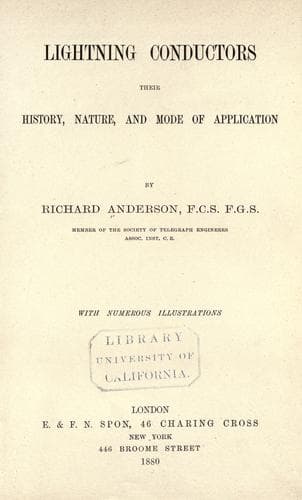
Lightning Conductors: Their History, Nature, and Mode of ApplicationAnderson, Richard, F.C.S.
History
Lightning Conductors: Their History, Nature, and Mode of Application
Anderson, Richard, F.C.S.
Lightning conductors
Thunderstorms are more numerous, on the average, in Schleswig-Holstein
than in any other part of Central and Northern Europe--due, probably,
to the fact of the province not only being a narrow peninsula, with the
Baltic on the east, and the German Ocean on the west, but intersected
by rivers and canals, producing a generally moist atmosphere. Almost
all public edifices in the province, and the great majority of private
buildings above the rank of mere cottages, are protected by lightning
conductors; and to aid in their extension there are special laws under
which damages by lightning are not made good, except to a limited
extent, by fire insurance companies, unless it is proved that the
edifices struck had been provided previously with efficient conductors.
These laws gave rise to a curious investigation some three or four
years ago. It was found that the principal fire insurance office--an
institution under the patronage of the Government, called the
‘Landesbrandkasse,’ or ‘County Fire Insurance Office’--had been called
upon a number of times to pay for damage caused by lightning in cases
where the buildings were provided with lightning conductors of the best
kind, in apparently perfect condition. Though the cases were very few
indeed--namely, but four out of 552 claims for damages from lightning
which had been made in the course of eight years--still, the interest
taken in the subject was so great, that the managers of the institution
appointed a special commissioner to inquire thoroughly into the
matter as to how it could happen that buildings provided with proper
conductors could ever be struck by lightning. The gentleman chosen to
undertake this task was Dr. W. Holtz, of Greifswald, well known as
having given much time to the study of the phenomena of electricity,
as well as the construction of lightning conductors. Dr. Holtz in due
course made his report, which was afterwards published in a scientific
journal called ‘Nachrichten des Naturwissenschaftlichen Vereins für
Neuvorpommern und Rügen,’ being the organ of a society under the latter
title. The report--which must be completely unknown in this country--is
full of interest, and well deserves being extracted from in several
notable particulars.
Public-domain text, read in full here on John Shaqi.
Reviews
Reviews
No reviews yet
Be the first to share your thoughts on this work.
Elsewhere in the archive
Join the Discussion
Join the discussion
Sign in to leave a comment or review.
Sign InorCreate an account