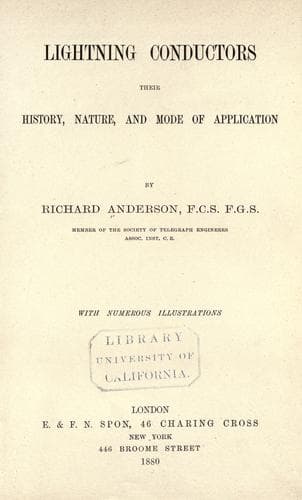
Lightning Conductors: Their History, Nature, and Mode of ApplicationAnderson, Richard, F.C.S.
History
Lightning Conductors: Their History, Nature, and Mode of Application
Anderson, Richard, F.C.S.
Lightning conductors
It is well remarked by Arago, that although we know nothing about
lightning, beyond the well-ascertained fact that it is one of the
manifestations of the equally vast and mysterious electric forces
pervading the universe, we yet may ascertain a great deal about
its mode of action by continued observation, made by many persons
and at many places. As yet the wise recommendation of the French
astronomer has, unfortunately, not been acted upon to any extent,
or in any systematic manner; still, a good many facts and incidents
have been gathered which serve to throw a strong light upon the
apparently erratic, but in reality normal manner in which, as in
obedience to some grand unfathomable cosmic law, the fire of the
clouds flashes along its self-made path. That these observations
are entirely modern, detracts nothing from their value. With all
their famed civilisation, the classical nations of the ancient world
never came to look upon lightning and thunderstorms as regular
functions of nature, but regarded them with dread and horror. Even
the greatest of their natural philosophers found in them means only
for encouraging popular superstition. Thus Pliny the Elder, in his
celebrated ‘Natural History,’ recommends, like Arago, notes being
taken about thunderstorms, but for quite a different purpose. ‘Nothing
is more important,’ says the celebrated author of the _Historia
Naturalis_, than to observe from what region the lightnings proceed,
and towards what region they return. Their return to the eastern
quarter is a happy augury. When they come from the east, the prime
quarter of the Heavens, and likewise return thither, it is the
presage of supreme felicity.’ It is reported by travellers that this
form of superstition--which has reference, of course, to the zigzag
form of many strokes of lightning, apparently in turn advancing and
retrograding--still exists in some districts of Southern Italy.
Public-domain text, read in full here on John Shaqi.
Reviews
Reviews
No reviews yet
Be the first to share your thoughts on this work.
Elsewhere in the archive
Join the Discussion
Join the discussion
Sign in to leave a comment or review.
Sign InorCreate an account