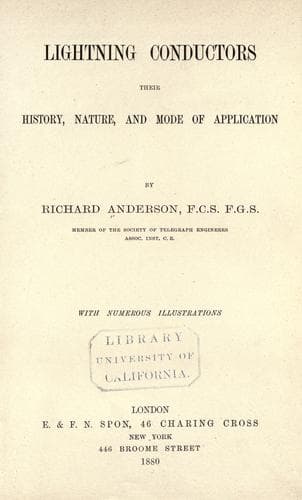
Lightning Conductors: Their History, Nature, and Mode of ApplicationAnderson, Richard, F.C.S.
History
Lightning Conductors: Their History, Nature, and Mode of Application
Anderson, Richard, F.C.S.
Lightning conductors
The superstitious awe with which lightning was looked upon not only
in ancient times, but in which it is still held by the ignorant at
the present day, finds its easy explanation both in the nature of
the terrifying phenomenon, and in the fact that even now we can only
speculate upon some of the causes of its seemingly capricious actions.
There can be no doubt that thunderstorms will visit some districts
in preference to others, and that lightning will descend constantly
upon some selected spots, and will entirely keep away from others.
As regards the latter case, old historians were fond of quoting the
grand temple of Solomon at Jerusalem, which was never struck by
lightning in the course of a thousand years, although thunderstorms
burst unceasingly over the Holy City, creating immense havoc and
destruction. In this instance at least, the explanation is simple,
although it may not be so in many others. It is stated expressly in
the biblical description of the building of the world-famed temple (1
Kings vi. 21, 22) that ‘Solomon overlaid the house within with pure
gold; and he made a partition by the chains of gold before the oracle;
and he overlaid it with gold. And the whole house he overlaid with
gold, until he had finished all the house; also the whole altar that
was by the oracle he overlaid with gold.’ If wise King Solomon had
known Franklin’s discovery of the protection against lightning given by
metallic conductors, he could not have guarded his magnificent edifice
better than he did by having ‘the whole house overlaid with gold,’
as stated in the Bible. But he did even more than this, according
to the historian Josephus, who records that the roof of the Temple,
constructed in what is now called the Italian style, was ornamented
from end to end with sharply pointed and thickly gilded pieces of
iron, in lancet form. These points, the historian surmised, were
placed there to prevent the birds from settling on the magnificent
roof, and soiling it, and it is very possible that this was the
original design. Nevertheless, it is certain that King Solomon guarded,
although, probably, without intending to do so, his magnificent temple
as perfectly against lightning, as could have been accomplished by
the best arranged system of conductors. It is not often that many
thousands of pounds are spent for protection against lightning, even
if intended for great cathedrals and splendid royal palaces; but King
Solomon disbursed, by the most trustworthy calculations, no less than
thirty-eight millions sterling in covering the temple with one of the
best of conductors--including the pointed and gilded lancets along the
roof, as perfect ‘Franklin rods’ as were ever designed by any architect.
Public-domain text, read in full here on John Shaqi.
Reviews
Reviews
No reviews yet
Be the first to share your thoughts on this work.
Elsewhere in the archive
Join the Discussion
Join the discussion
Sign in to leave a comment or review.
Sign InorCreate an account