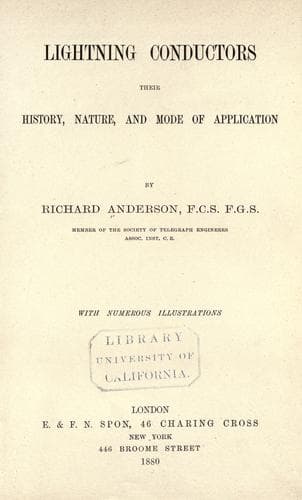
Lightning Conductors: Their History, Nature, and Mode of ApplicationAnderson, Richard, F.C.S.
History
Lightning Conductors: Their History, Nature, and Mode of Application
Anderson, Richard, F.C.S.
Lightning conductors
Another notable instance of low-lying storm-clouds, and which furnished
the rare opportunity of measuring the thickness of one of them,
occurred at the city of Gratz, Austria, on June 15, 1826. The city is
built along the side of a hill, the highest point of which, called the
Schlossberg, has on its summit a castle, now in ruins, but at the time
garrisoned by troops, and furnished with a small observatory. When
the storm in question broke over the city, several scientific men on
the Schlossberg took notes of the movement and direction of the great
cloud emitting its electric discharges. This they could easily do, as
they themselves, on their altitude, were standing in sunshine, under
a perfectly blue sky, the dark cloud-wave rolling deep under their
feet, indicating its path and size by streams of fire, following each
other in rapid succession. Exclusive of short flashes, vanishing in
the air as soon as seen, there fell nine great strokes of lightning
upon buildings in the city, in the course of about three quarters of
an hour, five of them causing conflagrations and killing a number of
people. The storm over, the observers compared their measurements, and
it was then found that the height of the storm cloud had never been
above the clock-tower of the Johanneum, an edifice connected with the
university, and containing a library and museum, while the lowest part
of it had gone down the sloping ground of the city no further than 120
feet under the summit of the clock-tower. This, then, was the exact
thickness of the storm-cloud which had caused so much destruction.
It was noticed on this occasion, as had been done often before, that
the discharges of lightning fell all upon buildings standing on moist
ground, near the river Mur, a mountain stream coming from the Noric
Alps, and dividing the city into two parts. There can be no doubt, from
thousands of observations made, that it is one of the characteristics
of the electric force to seek its way towards water--to be, as it were,
dissolved by it, or, as perhaps it might be said more truly, to be
equalised by it. A very remarkable electrical phenomenon, and one which
is often attended with fatal results to men and animals, is what is
known as the ‘return stroke’ of a lightning discharge. This is always
less violent than the direct stroke, but is nevertheless very powerful.
It is caused by the inductive action which a thunder-cloud exerts
on bodies placed within the sphere of its activity, and disastrous
effects often take place upon objects, upon men and animals on the
earth under the cloud, although perhaps miles away from the point
where the discharge takes place. These bodies are, like the ground,
charged with the opposite electricity to that of the cloud; but when
the latter is discharged by the recombination of its electricity with
that of the ground, the induction ceases, and all the bodies charged by
induction return to a neutral condition. The suddenness of this return
Public-domain text, read in full here on John Shaqi.
Reviews
Reviews
No reviews yet
Be the first to share your thoughts on this work.
Elsewhere in the archive
Join the Discussion
Join the discussion
Sign in to leave a comment or review.
Sign InorCreate an account