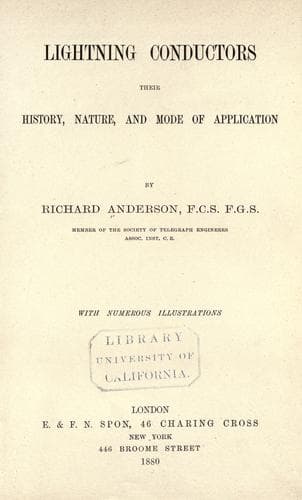
Lightning Conductors: Their History, Nature, and Mode of ApplicationAnderson, Richard, F.C.S.
History
Lightning Conductors: Their History, Nature, and Mode of Application
Anderson, Richard, F.C.S.
Lightning conductors
If some of the lightning-clouds tower at a gigantic elevation over the
earth’s surface, there are others that lie almost flat on it. There are
some remarkable observations on this kind in existence, made by German
meteorologists. Two of these deserve particular notice. On August 27,
a heavy storm burst over the town of Admont, on the river Ens, in
Styria, and the lightning, falling upon the lower part of the great
convent of the Benedictines, and passing through the wall, killed two
young priests near the altar, while reading vespers. The convent lies,
like the town of Admont, in a valley, and above it, some three hundred
feet higher, stands a castle, in which resided at the time a German
professor, specially interested in the phenomena of thunderstorms. He
watched assiduously the coming storm, and saw the lightning fall upon
the great convent, noticing all the while that the gilded cross placed
on the belfry of the edifice, about 115 feet from the ground, remained
standing out clear above the electric cloud, which appeared to come
close to the earth’s surface. He noticed further that above this cloud,
enveloping the ground portion of the Benedictine convent, there hovered
another, more than two thousand feet higher, and at intervals he could
see streaks of lightning fly from between the two, not however from the
more elevated to the lower one, but in a contrary direction. It was
evident that the two clouds must have been charged by electric forces
of different ‘degree,’ or ‘potential;’ it may be, one of a ‘negative’
and the other of a ‘positive’ kind, or, as Benjamin Franklin termed
them, ‘plus’ and ‘minus;’ although, as long as the forces differ in
‘degree’ or ‘potential,’ it is not essential that they be of opposite
kinds. As the marvellously sagacious discoverer of the lightning
conductor surmised, the wondrous force is really unitarian--that is,
throughout the same, the term ‘kind’ really only indicating on which
side of an assumed zero (the potential of the earth) the observations
or measurements are made.
Public-domain text, read in full here on John Shaqi.
Reviews
Reviews
No reviews yet
Be the first to share your thoughts on this work.
Elsewhere in the archive
Join the Discussion
Join the discussion
Sign in to leave a comment or review.
Sign InorCreate an account