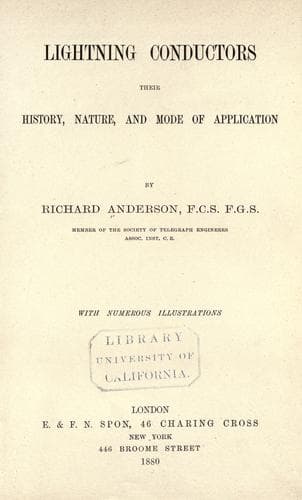
Lightning Conductors: Their History, Nature, and Mode of ApplicationAnderson, Richard, F.C.S.
History
Lightning Conductors: Their History, Nature, and Mode of Application
Anderson, Richard, F.C.S.
Lightning conductors
The inquiries into lightning protection instituted by the ‘Académie
des Sciences,’ and resulting in two reports, the second valuable in
the highest degree, had the good effect, not only of drawing public
attention to the necessity of providing such safeguards, but of
bringing the whole matter under due scientific control. Henceforth the
ground was cut away under ‘lightning-rod men,’ perambulating towns
and villages, and offering their trumpery ware--mostly bits of wire
tied together, with perhaps a lacquered piece of wood on the top--to
credulous persons, as a substitute for good conductors. The French
Government set a laudable example in appealing for the future always to
scientific aid. A few months after the publication of the ‘Instruction
sur les paratonnerres,’ drawn up by Professor Pouillet, a decision was
come to for protecting the new wings of the Louvre, at Paris, with the
most perfect lightning conductor that could be made, and thereupon
appeal for counsel was once more made to the ‘Académie des Sciences.’
The case was one of special interest. The palace of the Louvre, with
its inestimable treasures of art, had been the first public building
in France provided with a lightning conductor. It was due to the
initiative of an enthusiastic admirer of Benjamin Franklin, David Le
Roy, that this was accomplished, he having excited the public feeling
as to the dangers from lightning to which the Louvre was exposed to
such a degree as to compel the Government, in 1782, to carry out his
plans, under his own superintendence. The conductors erected by Le
Roy had stood the test of experience from 1782 until the year 1854,
many a thunderstorm having passed over the extensive buildings of the
Louvre without causing the least damage. But, in the last month of
1854, one more lightning cloud swept along the banks of the river
Seine, and the electric fire, falling on one of the chimneys of the
palace, knocked off a few bricks. The damage was very trifling, but
the alarm nevertheless was great, and very naturally so. If there was
one building in France, it was said, which ought to be beyond the risk
of being struck by lightning, it was the Louvre, and, if this could
not be accomplished, the art of constructing protective conductors was
altogether vain and ineffectual. It was under these circumstances,
incited by the public outcry, that the Government hastened to submit
the new case to the ‘Académie des Sciences.’
Public-domain text, read in full here on John Shaqi.
Reviews
Reviews
No reviews yet
Be the first to share your thoughts on this work.
Elsewhere in the archive
Join the Discussion
Join the discussion
Sign in to leave a comment or review.
Sign InorCreate an account