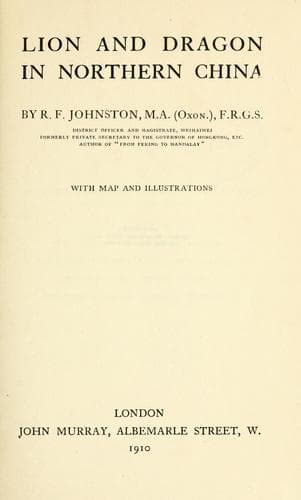
Lion and Dragon in Northern ChinaJohnston, Reginald Fleming, Sir
History
Lion and Dragon in Northern China
Johnston, Reginald Fleming, Sir
Weihai (China) -- History; Weihai (China) -- Social life and customs
As a rule we find in Weihaiwei either that each village is exclusively
inhabited by the people of one name, who are all inter-related and
address each other as brothers and uncles and nephews, or that
one "surname" is in numbers, wealth and social influence greatly
predominant over the others. Title-deeds and tombstones testify to
the antiquity of many of the existing Weihaiwei families; many of the
peasant-proprietors who share the land among them to-day are the direct
or collateral descendants of the people who tilled the same fields in
the days of the Sung, Yüan and Ming dynasties.
There are considerable numbers, however, whose ancestors were
immigrants from other parts of China; some of these were military
colonists, some were transferred by Government from other provinces
as a result of political or social troubles connected with rebellions
or famines. There are many well-known residents who themselves have
never travelled beyond the boundaries of the Wên-têng and Jung-ch'êng
districts, but who are well aware, from their carefully-preserved
pedigree-scrolls, that their ancestors were brought hither by
Government hundreds of years ago from provinces as far distant as
Yünnan. The Roman Emperors, we know, frequently adopted a similar
method of dealing with certain political exigencies, for they
transferred whole bodies of people from one province of the Empire to
another; but the fate of the transferred Chinese was better than that
of many of the Roman provincials, for they retained their independence
and did not become the serfs of overlords.
A typical village of Weihaiwei may be defined as consisting of a
group of families all bearing the same surname and all tracing their
descent from a single ancestor or a single ancestral stock, each
family in the group constituting a semi-independent unit, owning
its own lands, possessing certain rights over a common tract of
pasture-land and sharing in the rights and responsibilities connected
with the upkeep of the Ancestral Temple[75] and its tablets,[76] the
family burial-ground,[77] and any land or property that may have been
specially set apart to provide for the expenses of religious ceremonies
and sacrifices.[78] The more mixed a village becomes, that is, the
greater the number of "surnames" that it contains, the more widely does
it depart from the uniformity implied by this description. There may,
for example, be several ancestral temples, several burial-grounds,
many different patches of sacrificial land; though if the immigrants
came from a village in the vicinity, and have left there the main body
of their clan, it sometimes happens that they will still associate
themselves with the parent-village rather than with that in which they
live, and will therefore refrain from establishing new centres of
ancestral worship.
Public-domain text, read in full here on John Shaqi.
Reviews
Reviews
No reviews yet
Be the first to share your thoughts on this work.
Elsewhere in the archive
Join the Discussion
Join the discussion
Sign in to leave a comment or review.
Sign InorCreate an account