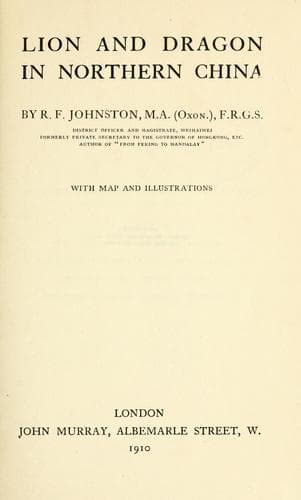
Lion and Dragon in Northern ChinaJohnston, Reginald Fleming, Sir
History
Lion and Dragon in Northern China
Johnston, Reginald Fleming, Sir
Weihai (China) -- History; Weihai (China) -- Social life and customs
While the images of the ox and _Mang-Shên_ are being prepared for the
approaching festival, a careful examination under official direction
is made of the newly-issued New Year's Almanac--the Chinese Zadkiel;
and the effigies are dressed up and decorated in accordance with
the prophecies and warnings of that publication. Hence the crowds
of people who go out to watch the procession on its way to meet the
Spring do so not only as a holiday diversion but also for the purpose
of inspecting the colours and trappings of the effigies and thereby
informing themselves of agricultural prospects for the ensuing year.
The prognostications are founded partly on astrology, partly on the _pa
kua_ or mystic diagrams of the _I Ching_ (Book of Changes), and partly
on calculations connected with _fêng-shui_. The colours and apparel
of the effigies correspond on an arbitrary system with the forecasts
of the Almanac. Thus if the people see that the head of the ox is
painted yellow, they know that great heat is foretold for the coming
summer; if it is green, there will be much sickness in the spring; if
red, there will be a drought; if black, there will be much rain; if
white, there will be high winds and storms. The _Mang-Shên_, also, is
a silent prophet of the seasons. If he wears a hat the year will be
dry; if he wears no hat there will be rain; shoes, similarly, indicate
very heavy rain; absence of shoes, drought; abundance of body-clothing,
great heat; lightness of clothing, cold weather. Finally, a red belt on
the _Mang-Shên_ indicates much sickness and many deaths; a white one,
general good health.
It will be noticed that the _Mang-Shên_, being a spirit, behaves in
a precisely contrary manner to ordinary mankind, and his garments
indicate exactly the opposite of what they would indicate if they were
worn by a living man. Thus he wears heavy clothes in hot weather,
light ones in cold weather; and as red is among men the colour that
denotes joy and prosperity and white betokens grief and mourning,
so the Mang-Shên wears red to indicate death and white to indicate
life and health. Thus it is that naughty children who take delight in
doing the opposite of what they are told to do are sometimes by their
long-suffering parents called "little Mang-Shên" or "T'ai Sui."
Public-domain text, read in full here on John Shaqi.
Reviews
Reviews
No reviews yet
Be the first to share your thoughts on this work.
Elsewhere in the archive
Join the Discussion
Join the discussion
Sign in to leave a comment or review.
Sign InorCreate an account