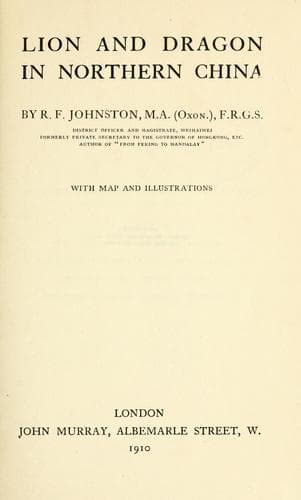
Lion and Dragon in Northern ChinaJohnston, Reginald Fleming, Sir
History
Lion and Dragon in Northern China
Johnston, Reginald Fleming, Sir
Weihai (China) -- History; Weihai (China) -- Social life and customs
If he wishes, as he often does, to protect his wife from the elder
lady's violence or bad temper he runs the risk of being denounced to
the neighbours--and perhaps to the local magistrate--as an unfilial
son; if he weakly and reluctantly takes his mother's side in a domestic
disagreement, or if--as is much more frequently the case--he pretends
to shut his eyes altogether to the quarrels of his women-folk, the wife
of his bosom may in a moment of anger or despair run away from him
or commit suicide. The only source of comfort to a young wife who is
unfortunate enough to displease her husband's mother is that some day,
in the course of nature, she herself will be in the proud position of a
mother-in-law. If she is of a cantankerous or tyrannical disposition,
or if her temper has been soured by her own domestic troubles, she will
then doubtless treat her son's wife with just as little kindness as she
received in her own early days of wifehood, and her daughter-in-law
will fear and dislike her just as she herself feared and disliked
her own husband's mother. Fortunately there are good and benevolent
mothers-in-law in Weihaiwei as well as bad ones: and it is only fair
to add that it is not always the wife who is meek and submissive and
the mother-in-law who wields the iron rod. Sometimes a high-spirited
and obstinate young woman will become absolute ruler of the
household--including her husband and his parents--before she has lived
a month in her new home, though her tenure of authority will always be
somewhat precarious until she has given birth to her first son. "Why
do you run away from a woman?" I once asked an unhappy husband whose
domestic troubles had driven him to the courts. "Is she not your wife,
and can you not make her obey you?" The young man's features broadened
into a somewhat mirthless smile as he replied, "I am afraid of her.
Eight men out of ten are afraid of their wives."
Women, indeed, are at the root of a large proportion of the cases
heard in the courts. No insignificant part of the duty of a magistrate
in Weihaiwei consists in the taming of village shrews. The number of
such women in China is much larger than might be supposed by many
Europeans, who regard the average Chinese wife as the patient slave
of a tyrannical master. The fact is that Chinese women, in spite of
their compressed feet and mincing gait, rule their households quite as
effectually as women do in countries further west, and in the lower
classes they frequently extend the sphere of their masterful activity
to their neighbours' houses as well. The result is not always conducive
to harmony. "For ther-as the womman hath the maistrie," wrote one of
the keenest students of human nature many centuries ago, "she maketh
to muche desray; ther neden none ensamples of this. The experience of
day by day oghte suffyse." This is a statement that multitudes of
woebegone husbands in Weihaiwei, were they readers of Chaucer, would
readily endorse.
Public-domain text, read in full here on John Shaqi.
Reviews
Reviews
No reviews yet
Be the first to share your thoughts on this work.
Elsewhere in the archive
Join the Discussion
Join the discussion
Sign in to leave a comment or review.
Sign InorCreate an account