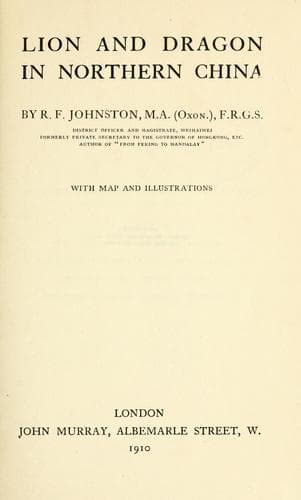
Lion and Dragon in Northern ChinaJohnston, Reginald Fleming, Sir
History
Lion and Dragon in Northern China
Johnston, Reginald Fleming, Sir
Weihai (China) -- History; Weihai (China) -- Social life and customs
This case was settled easily enough. Another bristled with difficulties
owing to the fact that the plaintiff, in his petition, avoided any
mention whatsoever of his real ground of complaint. "I have fifty _mu_
of land [about eight acres]. I have two sons, the elder Ta-chü, the
younger Erh-chü. In the second moon of this year they set up separate
establishments[159] and entered upon possession of the ancestral
lands. I was at that time in mourning for my wife, and beyond my
_yang-lao-ti_[160] had no means of support for my old age. After they
had left me, what with the expenses of my wife's funeral and my own
personal requirements I found myself in debt to the extent of sixty
_tiao_ [approximately equivalent to six pounds sterling]. My two sons
would not pay my debts: on the contrary they drove me out of my own
house and refused to give me food. I am hungry and in hardship. My
elder son, Ta-chü, at last relented and wanted to do something for
me, but he was knocked down by Erh-chü and is confined to bed. I have
reasoned with Erh-chü about his evil courses, but every time I do so he
only beats me. The whole village is disgusted with his treatment of me
but dares not interfere. Now I get wet through when it rains and I have
to beg for a living. There is no rest for me. My lot has fallen in hard
places. This son of mine is no better than a _hsiao ching_.[161] Is
this the way to preserve the sacred human relationships?"
In this circumstantial petition no word of complaint is made against
the real offender--the petitioner's second son's wife, who, as I soon
ascertained, was a shrew of the worst order. To bring the action
nominally against his second son was a clever device on the part of the
petitioner, for no Chinese magistrate dare--except in almost unheard-of
circumstances--take the word of a son against his own father, and an
unfilial son is one of the worst of criminals. The old man presumed,
therefore, that the case would be at once decided in his favour, and
that his son would be imprisoned. His son's wife, the shrew, would
then have been compelled to make reparation for her former misconduct
and undertake to become a reformed character. When she had done this
the old man would return to the magistrate and obtain her husband's
release. As it happened, the process was not so circuitous as this,
for the woman's misdeeds were discovered by the independent action of
the court, and it was she, not her husband, who was sent to gaol. She
was released as soon as her own father's family had come forward and
entered--very reluctantly--into a bond to guarantee her future good
conduct.
Public-domain text, read in full here on John Shaqi.
Reviews
Reviews
No reviews yet
Be the first to share your thoughts on this work.
Elsewhere in the archive
Join the Discussion
Join the discussion
Sign in to leave a comment or review.
Sign InorCreate an account