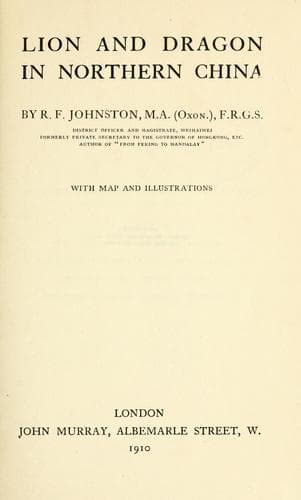
Lion and Dragon in Northern ChinaJohnston, Reginald Fleming, Sir
History
Lion and Dragon in Northern China
Johnston, Reginald Fleming, Sir
Weihai (China) -- History; Weihai (China) -- Social life and customs
These distinguished suicides, it should be hardly necessary to say,
have generally been women, and the glory of their deed has consisted in
the fidelity and heroism that have impelled them to follow their dead
husbands to the grave: but many of them are noble-minded statesmen and
patriots who have voluntarily sealed with their own blood some protest
against the follies or mistakes of emperors or have taken their own
lives as a means of drawing public attention to some grave danger that
menaced the State.[172]
We are accustomed to "topsy-turvydom" in China, and perhaps the
suicide-statistics might be cited as an example of this. "Suicide,"
says a recent writer on sociology, "is a phenomenon of which the male
sex possesses almost the monopoly."[173] If _female_ be substituted for
_male_ we have a fair statement of how affairs stand in Weihaiwei. Over
ninety per cent. of the persons who make away with themselves belong to
the female sex, and the great majority of them are young married women
or young widows. Since 1729, when it was proclaimed by imperial decree
that official honours were no longer to be conferred upon widows who
slew themselves on the occasion of their husbands' death, it has become
less common than formerly for young widows to practise the Chinese
equivalent of _sati_, but the custom is far from extinct, and at any
rate it seems to have left among women a readiness to fling away their
lives for reasons which to us appear singularly inadequate. Imperial
edicts did not and could not stamp out a custom which was of great
antiquity and deeply rooted in popular esteem. The British Government
in India forbade the practice of _sati_ long ago, and it has therefore
ceased to exist throughout the Indian Empire; but even now there is
strong reason to doubt whether popular opinion is on the side of the
Government in this matter, and whether the custom would not immediately
spring into vogue again if the British _raj_ were withdrawn.[174]
[Illustration: VILLAGE OF KU-SHAN-HOU, SHOWING HONORARY POLES IN FRONT
OF THE ANCESTRAL TEMPLE (see p. 324).]
[Illustration: MONUMENT TO FAITHFUL WIDOW, KU-SHAN-HOU (see p. 225).]
There is no doubt that the suicide of widows in China is a survival
of the ancient custom (which flourished in countries so far apart as
India and Peru, Africa and China) whereby wives and slaves were as a
matter of ordinary duty expected to follow their husbands and masters
to the grave; and though the day has probably long gone past when
such suicides were encouraged or actually enforced by the deceased's
relatives, it cannot be doubted that to this day public opinion in
China is strongly on the side of the widow who chooses to follow her
lord to the world of ghosts.[175]
Public-domain text, read in full here on John Shaqi.
Reviews
Reviews
No reviews yet
Be the first to share your thoughts on this work.
Elsewhere in the archive
Join the Discussion
Join the discussion
Sign in to leave a comment or review.
Sign InorCreate an account