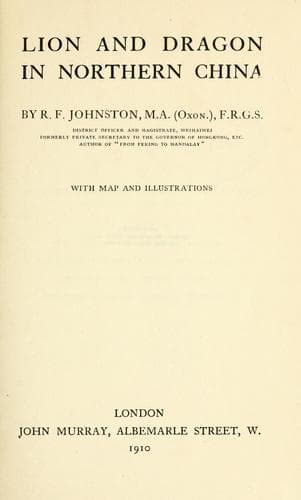
Lion and Dragon in Northern ChinaJohnston, Reginald Fleming, Sir
History
Lion and Dragon in Northern China
Johnston, Reginald Fleming, Sir
Weihai (China) -- History; Weihai (China) -- Social life and customs
Yü Lu Shih swore on the death of her husband that she would not live
alone. Her family wept bitterly and begged her to give up her intention
to die, but she replied, "I look upon death as a going home. The wise
will understand me." Then in the night-time she strangled herself.
Liu Shih, the daughter of Liu Fang-ch'ing of Ch'êng-shan (the Shantung
Promontory) was betrothed to a Weihaiwei man named T'ao Tu-shêng.
A "lucky day" was chosen for the marriage, and the bride was being
escorted to her new home on that day when the news was brought her
of the bridegroom's sudden death. She wished to follow him to the
grave,[179] but her father and mother prevented her from carrying
out her wish. When they began to relax their watchfulness she hanged
herself. The district-magistrate presented an honorary scroll to the
family to commemorate the girl's fidelity and chastity.
Chou Ch'i Shih was the wife of a literary student. Her husband died,
and she hanged herself on the following New Year's Eve.
Tung Tu Shih was the second wife of a graduate. On her husband's death
she starved herself to death. An edict was issued authorising the
erection of an honorific portal.
Chang Shih was betrothed in childhood to a man named Yüan. He died
before the marriage took place, when the girl was only sixteen. She
begged to be allowed to carry out the full mourning rites prescribed
for a widow, but her family would not hear of it.[180] She then hanged
herself. In the Shun Chih period (1644-61) a decree was received
authorising the erection of a commemorative portal. She and her
betrothed were buried together as man and wife. The portal was erected
at the side of the tomb. Elegies, funeral odes, essays, scrolls
containing laudatory couplets, were composed by many of the local poets
and scholars in honour of this virtuous woman.
Liu Yü Shih was the wife of a man who died when he was away from home.
She wailed for him bitterly, and said, "My husband is dead and it is my
duty to go down to the grave with him: but he has left no son to carry
on the ancestral sacrifices. Therefore my heart is ill at ease." She
then sold her jewellery in order to provide money enough to enable her
husband's younger brother to get married at once. A bride was selected
and the marriage took place. In a year a boy was born, and Liu Yü Shih
said, "Now my husband is no longer childless and I can close my eyes in
death." That night she hanged herself. [It should be noted that in such
a case as this it would be the duty of the younger brother to surrender
one of his own sons in order that he might become the son and heir of
the deceased. If the younger brother had only one son and there was
no other relative of the appropriate generation available to become
adopted son to the elder, the son would be allowed to inherit the
property of his uncle and father and to carry on the ancestral rites
for both. This is known as _shuang t'iao_.]
Public-domain text, read in full here on John Shaqi.
Reviews
Reviews
No reviews yet
Be the first to share your thoughts on this work.
Elsewhere in the archive
Join the Discussion
Join the discussion
Sign in to leave a comment or review.
Sign InorCreate an account