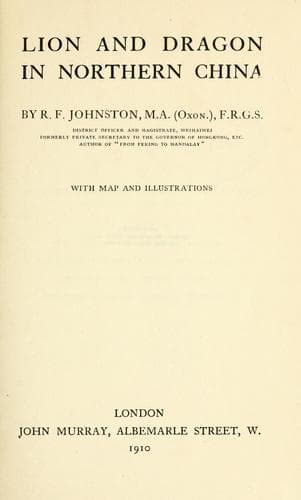
Lion and Dragon in Northern ChinaJohnston, Reginald Fleming, Sir
History
Lion and Dragon in Northern China
Johnston, Reginald Fleming, Sir
Weihai (China) -- History; Weihai (China) -- Social life and customs
On arrival at the home of Chang Shih, the _p'ai-wei_ was taken with
the deepest marks of respect out of the red chair and carried into the
house. It was reverently placed on a small shrine in the guest-chamber,
and in front of it were set a few small dishes of fruit and sweetmeats
and several sticks of burning incense. Then every member of the family
separately greeted it with a silent obeisance. When the time came for
departure, the _p'ai-wei_ was carefully carried out of doors again and
placed in the green chair, the red one being now occupied by Chang
Shih; and thus the strange bridal procession started home again, the
soul of the dead bridegroom escorting the body of the living bride.
On arrival at the house the _p'ai-wei_ was again taken out of its
chair and set up in the large hall where the dead man's family and
their guests were waiting to receive Chang Shih. For the time being
her widow's sackcloth had been cast aside, and she was clad in the
resplendent attire of a rich young bride. If her face bore signs of
inward emotion they were totally concealed beneath powder and rouge,
and not even her own parents could have told what thoughts or feelings
were uppermost at that time in their beautiful daughter's mind. She
went through the usual ceremonies that accompany a Chinese wedding, so
far as they could be carried out without the living presence of the
bridegroom.
Having paid the necessary reverence to Heaven and Earth, to the
souls of the ancestors of her new family, and finally to the living
members of that family in the order of their seniority, she retired
to the room that would in happier circumstances have been the bridal
chamber, and there she quickly divested herself of her gay wedding
robes and reassumed the dress of a widow in deepest mourning. Her
betrothed--her husband now--had already been laid in his coffin, but
in accordance with the usual Chinese custom many days had to elapse
between the coffining and the burial. Those days were devoted to the
elaborate rites always observed at a well-conducted Chinese funeral,
and the young girl having taken her place as chief mourner performed
her painful duties in a manner that gained her renewed respect and
admiration. At last came the day of the burial. From the home of
the living to the home of the dead marched a long procession of
wailing mourners robed in sackcloth; several bands of flute-players
and other musicians went in front and behind; there were scatterers
of paper money, coloured-flag bearers and trumpeters, whose duty it
was to conciliate and keep at a distance evil spirits and ill-omened
influences; there were lantern-bearers to pilot the dead man's soul;
there was a great paper image of the Road-clearing Spirit, borne in a
draped and tasselled pavilion; there was a dark tabernacle containing
the tablet to which the spirit of the deceased himself would in due
course be summoned; there was the long streamer, the _ling ching_ or
Public-domain text, read in full here on John Shaqi.
Reviews
Reviews
No reviews yet
Be the first to share your thoughts on this work.
Elsewhere in the archive
Join the Discussion
Join the discussion
Sign in to leave a comment or review.
Sign InorCreate an account