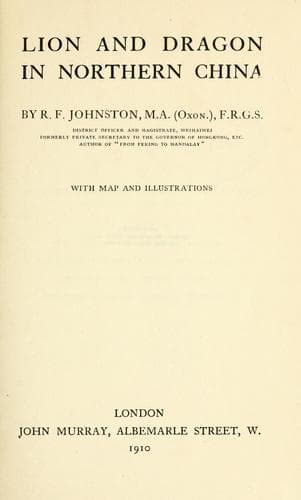
Lion and Dragon in Northern ChinaJohnston, Reginald Fleming, Sir
History
Lion and Dragon in Northern China
Johnston, Reginald Fleming, Sir
Weihai (China) -- History; Weihai (China) -- Social life and customs
In spite of these considerations, most Western readers, whatever may be
their views on the ethics of suicide, will probably confess themselves
utterly unable to understand how a young betrothed girl can work
herself into the state of intense emotional excitement which the act of
self-destruction implies, merely as the result of the untimely death
of the man to whom she happened to be engaged. The suicide of real
widows, distracted with grief for the loss of a beloved husband, they
can understand: but it cannot be love, and it can hardly be grief in
the ordinary sense, that induces a Chinese girl to throw away her life
when she hears of the decease of a young man with whom she has never
exchanged a word and whose face perhaps she has never seen. It may
be pointed out, in partial explanation of a phenomenon so strange to
Western notions, that not only is a betrothal in China practically as
binding as a marriage, but that marriage, and therefore the betrothal
that precedes it, are according to Chinese belief founded on mysterious
ante-natal causes. When the sceptical Englishman says jestingly that
"marriages are made in heaven" he is giving expression to a theory that
in China is held to be essentially true, though it is not expressed by
the Chinese in exactly the same terms. The theory is independent of
and perhaps older than Buddhism, though no doubt popular Buddhism has
done a great deal to strengthen it; and it has certainly helped to keep
the Chinese people satisfied with their traditional marriage customs,
which, as every one knows, are quite independent of love-making. It
is partly this theory that makes a Chinese woman contented and even
happy in the contemplation of her approaching marriage to an unknown
bridegroom, and often fixes in a girl's mind the idea that to give
herself to any man other than her first betrothed, even if the latter
died during the betrothal, would be as shameful a proceeding as to
commit an act of unfaithfulness in wedlock.
Probably it is only the fear of social disorder and many other
practical inconveniences that have prevented the second betrothals
and second marriages of women from being more severely discouraged by
public opinion than is actually the case. The first are in ordinary
practice passed over without comment, though the fact of the original
betrothal is "hushed up," or is at least not talked of; the second are
in many parts of China still regarded with austere disfavour, though
circumstances such as extreme poverty may render them necessary. In
any case, the girl who refuses a second betrothal is still honoured
and respected just as if she were a widow who had virtuously refused a
second marriage.
Public-domain text, read in full here on John Shaqi.
Reviews
Reviews
No reviews yet
Be the first to share your thoughts on this work.
Elsewhere in the archive
Join the Discussion
Join the discussion
Sign in to leave a comment or review.
Sign InorCreate an account