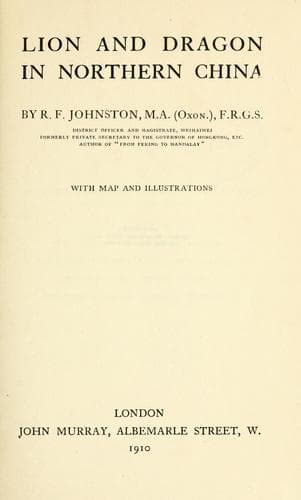
Lion and Dragon in Northern ChinaJohnston, Reginald Fleming, Sir
History
Lion and Dragon in Northern China
Johnston, Reginald Fleming, Sir
Weihai (China) -- History; Weihai (China) -- Social life and customs
This matter has been ably and thoroughly discussed by Dr. De
Groot,[198] who shows convincingly that "since very ancient times pines
and cypresses have played a prominent part as producers of timber for
coffins, and that this was the case because these trees, being believed
to be imbued with great vitality, might counteract the putrefaction of
the mortal remains." The same cause that made such timber valuable for
coffins made it valuable for graveyards. The superstition is connected
with the ancient Chinese philosophic doctrine of the _Yang_ and the
_Yin_--the complementary forces and qualities which pervade all nature,
such as male and female, light and dark, warmth and cold, activity and
passivity, positive and negative, life and death. It was supposed that
all evergreens must have a greater store of the _yang_ element (life,
vitality) than other trees, because they retain their foliage through
the winter; and of evergreen trees those prized most by the Chinese for
their life-giving qualities were and are the fir and the cypress.[199]
Therefore by planting these trees in their graveyards and in the
courtyards of their ancestral temples the Chinese supposed they would
endow their ancestors (apparently both their dead bodies and their
living spirits) with a never-failing preservative against decay and
dissolution. The result of this on themselves--the living descendants
of the dead--must be, it was thought, a constant flow of happiness and
good fortune.
It will be remembered that ancestor-worship is not merely regarded as
a method of showing love and reverence for the dead but is believed
to induce the ancestral spirits to protect and watch over the family
and to bestow on its members long life, many children and general
prosperity. The more abundant the vitality (if one may speak of the
vitality of a ghost) that can be imparted to the ancestral spirits, the
better able will they be (so goes the theory) to exert themselves on
behalf of the fortunes of their posterity; and the best way to impart
vitality (that is, the _yang_ element) to the spirits is to surround
their coffins and their ancestral tablets with as many _yang_-supplying
agencies as possible. The original theory of the matter is probably
extinct at Weihaiwei if not everywhere else; trees are planted and
protected in the family temples and graveyards for no known reason
except that it is the traditional custom to do so[200]: yet it is
noteworthy that the cypress is still the favourite tree in the grounds
of the ancestral temples, that the fir is still considered one of the
best trees to plant in a graveyard, and that the pedigree-scrolls
preserved among the archives of every family are often decorated with
the painting of an evergreen tree.[201]
Public-domain text, read in full here on John Shaqi.
Reviews
Reviews
No reviews yet
Be the first to share your thoughts on this work.
Elsewhere in the archive
Join the Discussion
Join the discussion
Sign in to leave a comment or review.
Sign InorCreate an account