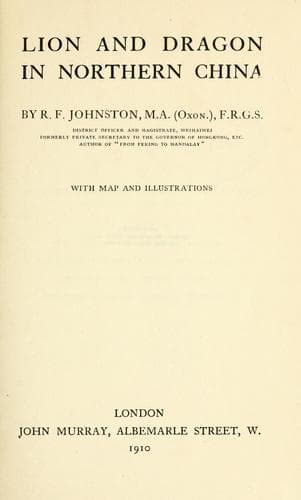
Lion and Dragon in Northern ChinaJohnston, Reginald Fleming, Sir
History
Lion and Dragon in Northern China
Johnston, Reginald Fleming, Sir
Weihai (China) -- History; Weihai (China) -- Social life and customs
The date and hour of death, the date of intended burial, the age and
sex and star-influences of the deceased, and many variable local and
temporary circumstances all have to be taken into consideration before
the _hsien-shêng_ can advise his client as to the best possible site
for any required grave. Certain parts of the graveyard are always more
"honourable" (in the heraldic sense) than others from the point of
view of family precedence and seniority. The back, centre and front
portions of the ground are reserved for married couples who have left
children and therefore take an honoured place in the family pedigree,
whereas members of the family who have died unmarried or in childhood
are either not accommodated in the family graveyard at all, or, if
admitted, they are buried close to the right or the left boundary. A
villager was once brought before me on the charge of having buried
his dead infant, a child of two years old, in a part of the graveyard
that was reserved for its dignified elders. As it is advisable in such
matters to uphold local custom I felt reluctantly obliged to order the
man to remove his child's body to that part of the graveyard which is
regarded as appropriate for those who have died in infancy.
If a family has had a long run of misfortune or misery and sees no way
of extricating itself from its difficulties, it will sometimes try
to throw the blame on its graveyard: not, of course, on the spirits
of its ancestors but merely on the unpropitious influences that hang
round the sites of the family tombs. The only possible remedy in such a
case is to employ a _hsien-shêng_ to study the geomantic conditions of
the locality and advise as to what can be done to improve them. He is
almost sure to agree with his employers that their surmise is correct
and that the badly-situated graveyard is the cause of all their woes,
for he will then be able to proceed to the lucrative task of selecting
a new graveyard-site and superintending the removal of the graves. The
only case of this nature that has come within my personal experience is
interesting as throwing a light on the _hsien-shêng_'s method of work.
It is probable that many other cases have occurred even in Weihaiwei,
but as geomantic superstitions are frowned upon by Chinese law, and the
unnecessary removal of graves on the plea of finding better _fêng-shui_
is a penal offence, _yin-yang_ professors naturally ply their trade
with as little ostentation as possible.
Public-domain text, read in full here on John Shaqi.
Reviews
Reviews
No reviews yet
Be the first to share your thoughts on this work.
Elsewhere in the archive
Join the Discussion
Join the discussion
Sign in to leave a comment or review.
Sign InorCreate an account