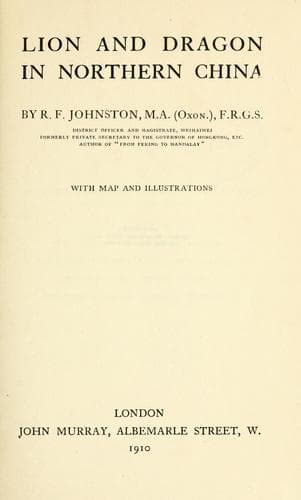
Lion and Dragon in Northern ChinaJohnston, Reginald Fleming, Sir
History
Lion and Dragon in Northern China
Johnston, Reginald Fleming, Sir
Weihai (China) -- History; Weihai (China) -- Social life and customs
Yet it must not be supposed that there is no such thing as Confucianism
in China outside the ranks of the official classes. Confucian ideals
of life and conduct, Confucian doctrines of the relations between
rulers and ruled, Confucian views of the reciprocal rights and duties
of parents and children, friends, neighbours, strangers, the Confucian
sanction of the cult of Ancestors, these are all strong living forces
in the China of to-day. "Wherever Chinamen go," says Dr. H. A. Giles,
"they carry with them in their hearts the two leading features of
Confucianism, the patriarchal system and ancestral worship."[252] The
influx of new light from the West is doubtless bringing about a change
in the traditional attitude of the Chinese towards the person of the
teacher whom their forefathers have revered for more than two thousand
years; but though the Confucian cult conceivably at some future time
may be formally disestablished and the Confucian temples turned into
technical colleges, it is to be hoped for the sake of China that
many centuries will elapse before Confucianism as a moral force, as
a guide of life, fades away from the hearts and minds of the people.
Confucianism is not a mere code of rules that can be established or
abrogated as the fancy takes any prominent statesman who happens to
have the ear of the throne; it has intertwined itself with the very
roots of the tree of Chinese life, and if that venerable tree, in spite
of a mutilated branch or two, is still very far from hopeless decay it
is to Confucianism that much of its strength and vigour is due.[253]
Perhaps no teacher of antiquity has suffered more disastrously at the
hands of most of his interpreters and translators than has Confucius.
Even his Chinese commentators have not always been successful; it
is then little to be wondered at that European students, often
lacking both a complete equipment of Chinese scholarship and a
power of sympathetic insight into alien modes of thought, and above
all possessed by an intensely strong bias against "heathendom"
and "heathen" thinkers, have failed again and again to give their
fellow-countrymen an adequate account either of the Confucian system as
a whole or of the personal character of the Master himself.
Confucius, as one of his most recent English translators reminds us,
was one of the most open-minded of men, and approached no subject
with "foregone conclusions"; but the whole attitude of the Englishman
who is still regarded as the great expounder of Confucianism to the
English-speaking world (Dr. Legge) "bespoke one comprehensive and fatal
foregone conclusion--the conviction that it must at every point prove
inferior to Christianity."[254]
Now what is the impression that Confucianism gives to a European
student who is not only a good Chinese scholar and therefore able to
dispense with translations, but is also entirely free from religious
prejudice?
Public-domain text, read in full here on John Shaqi.
Reviews
Reviews
No reviews yet
Be the first to share your thoughts on this work.
Elsewhere in the archive
Join the Discussion
Join the discussion
Sign in to leave a comment or review.
Sign InorCreate an account