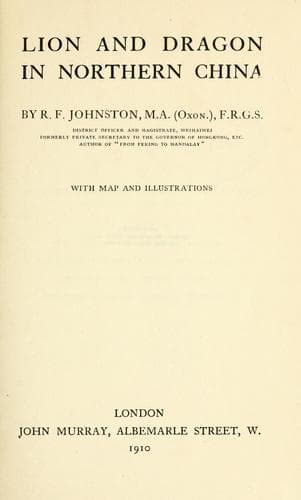
Lion and Dragon in Northern ChinaJohnston, Reginald Fleming, Sir
History
Lion and Dragon in Northern China
Johnston, Reginald Fleming, Sir
Weihai (China) -- History; Weihai (China) -- Social life and customs
I have italicised the words that are of special interest when
considered in connection with the statement already quoted from
Mr. Lionel Giles. It is true that the praise given to the Japanese
is a great deal too high: there is no nation, whether Christian or
non-Christian, that deserves such praise. At the same time most
Europeans might find it no easy task to prove to the satisfaction of
an intelligent visitor from another planet that the Christian nations
are, on the whole, more virtuous than the people of Japan. The European
advocate would, of course, lay stress on the alleged weakness of
Japanese commercial morality, and perhaps with very good cause. But
there is no valid reason for supposing that the Japanese, without
Christianity, cannot and will not amend their ways in this respect, and
in any case commercial immorality receives no more justification from
Confucian than it does from Christian ethics.[260]
But Japan is not China: and if Confucianism be such a good thing,
exclaims the wondering European, how is it that China is in a state
of decay, that Chinese officials are corrupt, that the population
is sodden with opium, that the country is only now, after centuries
of sloth and stagnation, beginning to show an interest in Western
civilisation and modern science? The real condition of China, or
at least of the Chinese people, is perhaps not so rotten as it is
sometimes believed to be, in spite of the grave political and social
dangers that at present lie ahead. But waiving this point and admitting
that reforms are coming not a day too soon, let us consider one or two
of the most obvious causes to which the present state of China may be
attributed. China was for many centuries so easily supreme in her own
quarter of the globe that a strenuous life became for her unnecessary.
Conflict is a law of nature, but owing to peculiar circumstances
China as a nation became to a great extent temporarily exempt from
that law.[261] She sank into inactivity because it was not necessary
for her, as it was and is for the great nations of Europe, to be
continually sharpening her wits against those of her neighbours, or to
be for ever engaged in the Sisyphean task of redressing "the balance
of power." Do the nations of modern Europe sufficiently realise to
what extent they owe their progress and civilisation and even their
mechanical inventions to the fact that they have all been pitted
against each other in a more or less equal struggle for existence in
which none has ever succeeded in establishing a supremacy over all
the rest? Had powerful and united non-Chinese kingdoms established
themselves in the Indo-Chinese peninsula, in India itself, in the
plains and mountains of Tibet and Mongolia, in Korea and in mediæval
Japan,--kingdoms capable of contending with China on fairly level
terms, competent to defend themselves against her attacks yet not
strong enough to overcome her,--can it seriously be supposed that
Public-domain text, read in full here on John Shaqi.
Reviews
Reviews
No reviews yet
Be the first to share your thoughts on this work.
Elsewhere in the archive
Join the Discussion
Join the discussion
Sign in to leave a comment or review.
Sign InorCreate an account