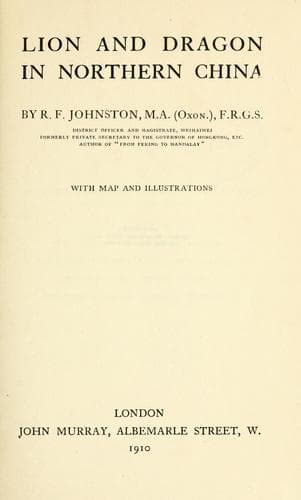
Lion and Dragon in Northern ChinaJohnston, Reginald Fleming, Sir
History
Lion and Dragon in Northern China
Johnston, Reginald Fleming, Sir
Weihai (China) -- History; Weihai (China) -- Social life and customs
"My advice to you is this. Be zealous in the services you owe to your
fellow-men; behave towards them as you would wish them to behave
towards yourself. Be not too proud to admit when you are wrong or
that you 'do not know.' The man who sees what is right and honest and
dares not do it is a craven. Do not repine if you are misunderstood
by men; repine rather that there are men who are misunderstood by
you. Choose as your familiar companions only those who are at least
equal to yourself in virtue. Speak and act with sincerity and truth.
Be true to yourself and charitable towards your neighbour. Carry out
those rites of filial piety and of religious worship that have been
handed down to you by your fathers, even if you have doubts about the
nature or even the very existence of the objects of your worship;
there is nothing to be ashamed of in honest doubt, but do not let
doubts interfere with your duty. Let not your knowledge and practice
of the traditional rituals mislead you into thinking that you are on
intimate terms with the spiritual world; treat the unseen Powers with
all reverence but keep aloof from them. Do not fear that God will
hold you guilty of neglect of heavenly things provided you neglect
nothing of the duties you owe to men."
It is true that several remarks of Confucius are on record which seem
to indicate that he had a belief--however indefinite--in the existence
of a God or at least of spiritual beings who were both greater and
better than men. For instance he is said to have remarked that men had
failed to understand him, adding proudly, "But there is Heaven: THAT
knows me!" There is also the famous reply which he gave to Tzŭ-lu on
the subject of prayer: "My praying," said Confucius, "has been for a
long time."[299] Some English translators incline to the opinion that
according to this remark Confucius really did offer up prayers to an
unseen Power. What one knows of Confucius's life and teachings as well
as the context of this particular passage makes this highly improbable;
and indeed the remark loses most of its beauty and dignity if Confucius
referred merely to prayers in the ordinary sense. As one of his English
editors says, "his whole life had been one long prayer"[300]--in a
sense that the narrow religious pedant perhaps does not and cannot
understand. One is reminded of the landscape-painter who scandalised
the pious natives of a beautiful Welsh village by painting on Sundays.
"How is it," asked the local parson reproachfully, "that we have not
yet seen you in God's house?" "I am not aware," was the artist's quiet
reply, "that I was ever out of it." Those of us who can respect this
answer will be able to respect that given by Confucius when he said,
"My praying has been for a long time."
FOOTNOTES:
Public-domain text, read in full here on John Shaqi.
Reviews
Reviews
No reviews yet
Be the first to share your thoughts on this work.
Elsewhere in the archive
Join the Discussion
Join the discussion
Sign in to leave a comment or review.
Sign InorCreate an account