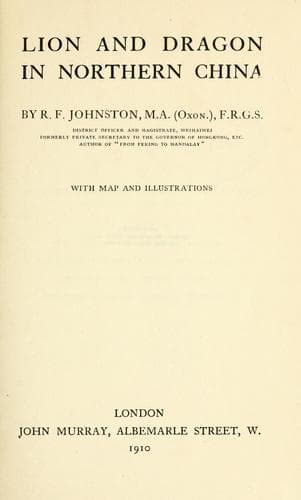
Lion and Dragon in Northern ChinaJohnston, Reginald Fleming, Sir
History
Lion and Dragon in Northern China
Johnston, Reginald Fleming, Sir
Weihai (China) -- History; Weihai (China) -- Social life and customs
[267] See Legge's _Chinese Classics_ (2nd. ed.), vol. i. p. 100.
[268] Sir Robert Douglas, _Confucianism and Taouism_ (5th ed.), p. 146.
[269] This would certainly have been Montaigne's view. See, for a very
apposite passage, _Essays_, Bk. iii, ch. i.
[270] This is Legge's translation of _Lun Yü_ i. 8. The doctrine is
repeated in ix. 24. Cf. also _Lun Yü_ ii. 22 and many other passages in
this and other Confucian books.
[271] Sir Robert Douglas, _op. cit._ p. 114.
[272] "Confucianism," in _Great Religions of the World_, p. 26. See
also Prof. Giles's _Chinese Literature_, p. 48, and Wylie's _Notes on
Chinese Literature_ (1902 ed.), p. 82.
[273] See pp. 108 _seq._
[274] _Principles of Ethics_, i. 402. Herbert Spencer goes on to refer
to 1 Kings xxii. 22, Ezekiel xiv. 9, Genesis xxvi. 12, and also to
the Jacob and Esau incident and to the occasion "when Jeremiah tells
a falsehood at the king's suggestion." The Rev. A. W. Oxford, writing
on ancient Judaism, reminds us that "Jehovah protects Abraham and
Isaac after they have told lies, and punishes the innocent foreigner."
_Religious Systems of the World_ (8th ed.), p. 60.
[275] _Herodotus_, translated by G. C. Macaulay, vol. i. pp. 69-70.
[276] Herbert Spencer, _op. cit._ vol. i. pp. 403-4.
[277] Both cases are cited by Herbert Spencer, _op. cit._ p. 405. That
philosopher argues that "it is the presence or absence of despotic rule
which leads to prevalent falsehood or prevalent truth."
[278] Prof. Legge evidently took the view that truthfulness belonged
only to Christians. He states that a love of truth can only be
maintained, and a lie shrunk from with shame, through "the living
recognition of a God of truth, and all the sanctions of revealed
religion." (_Chinese Classics_, vol. i. p. 101.) By "revealed religion"
Legge means, of course, Christianity. It would be interesting to
know how he would have accounted for truthfulness among numerous
non-Christian races of our own time or among such people as the ancient
Persians. Perhaps as regards the latter case he would have done it by
denying the capacity of a Greek (especially of a Greek who has been
described as the "father of lies") to judge of truthfulness! Prof.
Martin in _The Lore of Cathay_ (p. 177) says that while Confucius's
writings (presumably he means his recorded sayings) "abound in the
praise of virtue, not a line can be found inculcating the pursuit of
truth." This is an amazing misstatement: let us hope it was written
inadvertently. A third missionary, Dr. Wells Williams, makes statements
regarding the character and morals of the Chinese people that are so
grossly unfair as to be almost unreadable [_Middle Kingdom_, vol. i.
pp. 833-6 (1883 edition)]. Mr. Arthur Davenport in his _China from
Within_ (T. Fisher Unwin, 1904) quotes from a missionary's letter which
appeared in _China's Millions_ (a missionary publication) in February
1903. "What a mass of evil the missionary in China has to contend
with!...
Public-domain text, read in full here on John Shaqi.
Reviews
Reviews
No reviews yet
Be the first to share your thoughts on this work.
Elsewhere in the archive
Join the Discussion
Join the discussion
Sign in to leave a comment or review.
Sign InorCreate an account