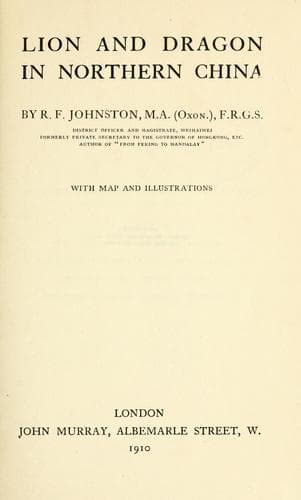
Lion and Dragon in Northern ChinaJohnston, Reginald Fleming, Sir
History
Lion and Dragon in Northern China
Johnston, Reginald Fleming, Sir
Weihai (China) -- History; Weihai (China) -- Social life and customs
and therefore, as we have seen, the territory temporarily administered
by Great Britain contains portions of both Wên-têng and Jung-ch'êng
districts.
In most magisterial districts which include seaports or large
market-centres there are certain small officials styled _hsün-chien_
who reside at such places and carry on the routine and minor duties
of civil government and police administration on behalf and under the
authority of the district-magistrates. A _hsün-chien_ in fact presides
over what may be called a sub-district and acts as the magistrate's
deputy. Before Weihai ceased to be a Wei an official of this class
resided near what was then the northern boundary of the Wên-têng
magistrate's jurisdiction, namely at a place called Wên-ch'üan-chai.
When the Wei was absorbed in the Wên-têng district in 1735 and the
boundaries of that district were thus made to include all the land
that lay to the north, the sub-district of Wên-ch'üan-chai was
abolished, and a new sub-district created at Weihai with headquarters
at Weihai city. The last _hsün-chien_ of Wên-ch'üan-chai became the
first _hsün-chien_ of Weihai, and the former place sank at once into
the position of an ordinary country village. Wên-ch'üan-chai must not
be confused with Wên-ch'üan-t'ang, the headquarters of the South
Division of the territory under British rule;[36] the two places are
several miles apart, though both at present fall within the magisterial
jurisdiction of the British District Officer. It is interesting to note
that Wên-ch'üan-t'ang itself was long ago--probably before the days of
the Ming dynasty--the seat of a military official, the site of whose
yamên is still pointed out by the people of the locality. The last
_hsün-chien_ of Wên-ch'üan-chai, who was transferred to Weihai city,
was a man of such excellent reputation that his name is remembered
with respect to this day. The people of the neighbourhood still repeat
a well-known old rhyme which he was fond of impressing upon their
ancestors' minds:
"_Shan yü shan pao
O yü o pao
Jo shih pu pao
Shih-ch'ên wei tao._"
This being translated means:
"Happiness is the reward of virtue; misery is the reward of wickedness.
If virtue and wickedness have not brought their due recompense it is
only because the time has not yet come."
This man, whose name was Yang, is said to have been so upright and
clean-handed an official that when he was relieved of office he found
himself without funds sufficient to take him home to his native place,
which was a long way off. However, being connected by marriage with the
Li family of Ai-shan-ch'ien,[37] he took up his residence with them and
there spent the remainder of his life. He was buried in the graveyard
of the Li family, where his tomb is still to be seen.
Public-domain text, read in full here on John Shaqi.
Reviews
Reviews
No reviews yet
Be the first to share your thoughts on this work.
Join the Discussion
Join the discussion
Sign in to leave a comment or review.
Sign InorCreate an account