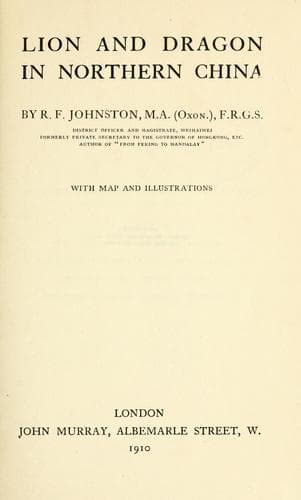
Lion and Dragon in Northern ChinaJohnston, Reginald Fleming, Sir
History
Lion and Dragon in Northern China
Johnston, Reginald Fleming, Sir
Weihai (China) -- History; Weihai (China) -- Social life and customs
The strong rule of the early Ta Ch'ing Emperors (the Manchu dynasty)
had its natural effect throughout the whole country. Law-abiding folk
enjoyed the fruits of their industry without molestation, while robbers
and pirates found their trade both more dangerous and less profitable
than in the good old days of political disorder. Yet it was not to be
supposed that even the great days of K'ang Hsi and his two remarkable
successors were totally unmarked by occasional troubles for the people
of so remote and exposed a section of the Empire as north-eastern
Shantung. The year 1703, say the local annals, was a disastrous one,
for floods in spring and a drought in summer were followed in autumn by
the arrival at Weihaiwei of shiploads of Chinese pirates. Soldiers from
the neighbouring camps of Ning-hai, Fu-shan (Chefoo) and Wên-têng had
to be sent for to assist the local garrison in beating them off. Nine
years later, on the seventeenth day of the tenth month, pirates arrived
at the island of Chi-ming,[34] whereupon a great fight ensued in which
a brave and distinguished Chinese commander lost his life.
An important year for the districts we are considering was 1735. For
some years previous to this the question of the abolition of the
various Wei and amalgamating them with the appropriate Hsien had been
eagerly discussed in civil and military circles. The question was
not, indeed, one of dismantling fortifications or denuding the place
of troops: these, it was reluctantly recognised, were a permanent
necessity. The disputed point was merely one of jurisdiction and
organisation. As we have seen, the Wei were something quite exceptional
in the Chinese administrative system; the creation of districts under
direct military control, free from any interference on the part of the
civil magistrates, had been in Chinese eyes a dangerous departure from
the traditional administrative practice of past ages and could not be
justified except as a temporary measure, which, being bad in principle,
should only be resorted to under pressure of abnormal conditions.
Several of the memorials and despatches written for and against the
retention of the Wei are preserved in the printed Annals of the
districts concerned. The matter was considered of such grave importance
that a provincial governor and a governor-general were separately sent
by the central Government to inquire into local conditions at the
north-eastern peninsula and to prepare detailed reports on the problems
of administration and defence. The end of it all was that in 1735 the
several Wei were abolished: Weihaiwei resumed its old place within the
magistracy of Wên-têng, while the Promontory Wei of Ch'êng-shan was
converted into a new magisterial district under the name of Jung-ch'êng
Hsien. Similar fates befell the other Wei of eastern Shantung, such
as Ching-hai, Ta-sung and Ning-hai. The boundary of Jung-ch'êng was
placed as far west as the villages of Shêng-tzŭ and Ch'iao-t'ou,[35]
Public-domain text, read in full here on John Shaqi.
Reviews
Reviews
No reviews yet
Be the first to share your thoughts on this work.
Join the Discussion
Join the discussion
Sign in to leave a comment or review.
Sign InorCreate an account