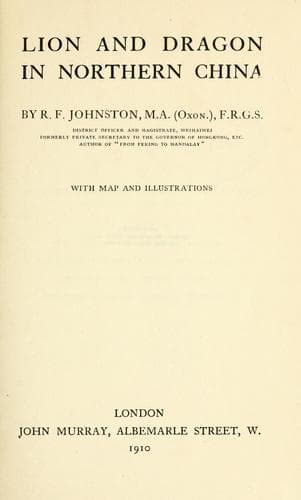
Lion and Dragon in Northern ChinaJohnston, Reginald Fleming, Sir
History
Lion and Dragon in Northern China
Johnston, Reginald Fleming, Sir
Weihai (China) -- History; Weihai (China) -- Social life and customs
These extracts from the local chronicles are perhaps enough to prove
that the Weihaiwei peasant has not always lain on a bed of roses. When
we know him in his native village, and have learned to appreciate his
powers of endurance, his patience, courage, physical strength and
manly independence, and remember at the same time how toilfully and
amid what perils his ancestors have waged the battle of life, we shall
probably feel inclined either to dissociate ourselves forthwith from
the biological theory that denies the inheritance of acquired qualities
or to recognise that the principle of natural selection has been at
work here with conspicuous success.
The chief boast of the Promontory district, including Weihaiwei, is
or should be its sturdy peasantry, yet it is not without its little
list, also, of wise men and heroes. Weihaiwei, like other places, has
its local shrine for the reverential commemoration of those of its
men and women who have distinguished themselves for _hsien_, _chieh_,
_hsiao_--virtue, wifely devotion and filial piety; and the accounts
given us in the official annals of the lives and meritorious actions
of these persons are not without interest as showing the nature of the
deeds that the Chinese consider worthy of special honour and official
recognition.[42]
On the northern slope of Wên-têng Shan, near the city of that name, is
the tomb of _Hsien Hsien Shên Tzŭ_--the Ancient Worthy Shên. He was a
noted scholar of the Chou dynasty (1122-293 B.C.). The T'ang dynasty
honoured him (about one thousand years or more after his death) with
the posthumous title of Earl of Lu (Lu Pai). The Sung dynasty about the
year 1012 A.D. created the deceased philosopher Marquess of Wên-têng
(Wên-têng Hou). His descendants--no longer of noble rank--are said
to be still living in the ancestral village of Shên-chia-chuang (the
village of the Shên family), his native place. In 1723 a new monument
was erected at his grave by the district-magistrate of that time, and
the custom was established for the local officials to offer sacrifices
at the marquess's tomb three days before the Ch'ing-ming festival.[43]
Close to Wên-ch'üan-t'ang (the headquarters of the South Division
of Weihaiwei under British rule) is to be seen the grave of one
Yü P'êng-lun, who during the terrible period 1639-43 honourably
distinguished himself by opening soup-kitchens along the roadsides. He
also presented a free burial-ground for the reception of the bones of
the unknown or destitute poor who had starved to death. Free schools,
moreover, and village granaries were founded by this enlightened
philanthropist. After his death the Board of Rites in 1681 sanctioned
his admission into the Temple of Local Worthies.
In 1446 were buried close to Weihaiwei the remains of a great general
named Wei (_Wei chiang-chün_) who had done good service against the
Japanese.
Public-domain text, read in full here on John Shaqi.
Reviews
Reviews
No reviews yet
Be the first to share your thoughts on this work.
Elsewhere in the archive
Join the Discussion
Join the discussion
Sign in to leave a comment or review.
Sign InorCreate an account