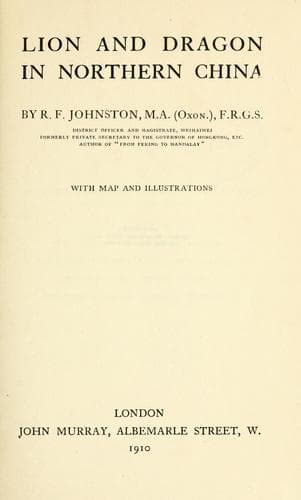
Lion and Dragon in Northern ChinaJohnston, Reginald Fleming, Sir
History
Lion and Dragon in Northern China
Johnston, Reginald Fleming, Sir
Weihai (China) -- History; Weihai (China) -- Social life and customs
This is a picture of gloomy possibilities which, it is to be hoped,
will never be realised so long as the British occupation of Weihaiwei
subsists. Unfortunately, diplomatic difficulties are not the only
possible causes of trouble. If eastern Shantung were afflicted with
long-continued drought and consequent famine--not an uncommon event--or
if it were visited by some of those lawless bands of ruffians, too
numerous in China, who combine the business of robbery and murder with
that of preaching the gospel of revolution, the position of Weihaiwei
would not be enviable. And parts of China, be it remembered, are
in such a condition at present that almost any day may witness the
outbreak of violent disorder. A small band of hungry and desperate
armed men with a daring leader, a carefully-prepared plan and a good
system of espionage--were it not for the Boy Scouts of the Weihaiwei
School, who are fortunately still with us!--descend upon Port Edward,
glut themselves with booty, and be in a safe hiding-place beyond the
British frontier before noon the next day. Much more easily could
any village or group of villages be ransacked and looted, and its
inhabitants killed or dispersed: and the local Government, except by
summoning extra assistance, would be powerless under present conditions
to take any vigorous action.
Trouble of this kind is much more likely to come from the Chinese of
some distant locality than from the people of the Territory itself. In
one very important respect the British have been highly favoured by
fortune. It happens that harvests in Weihaiwei for several years past
have been on the whole very good, and the people are correspondingly
prosperous. There has not been a really bad year since British rule
began; moreover certain agricultural developments (especially the
cultivation on a large scale of ground-nuts intended for export) have
been beneficial to the soil itself, and are a steadily-increasing
source of wealth to the farmers. With the loose conceptions of cause
and effect common to most peasant-folk, many of the villagers believe
that the good harvests and general prosperity are somehow due to the
"luck" of their alien rulers, of which they derive the benefit. The
gods and spirits of the land, they imagine, must be satisfied with the
presence of the British: is it not obvious that they would otherwise
show their discontent by bringing a blight on the fields or sending a
plague of insects?
Public-domain text, read in full here on John Shaqi.
Reviews
Reviews
No reviews yet
Be the first to share your thoughts on this work.
Elsewhere in the archive
Join the Discussion
Join the discussion
Sign in to leave a comment or review.
Sign InorCreate an account