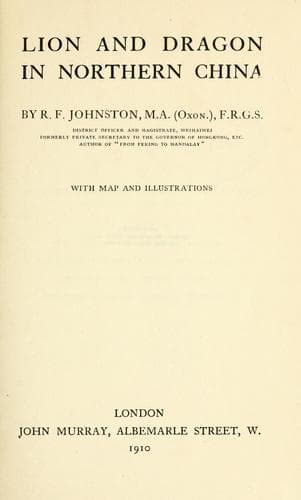
Lion and Dragon in Northern ChinaJohnston, Reginald Fleming, Sir
History
Lion and Dragon in Northern China
Johnston, Reginald Fleming, Sir
Weihai (China) -- History; Weihai (China) -- Social life and customs
The causes of litigation in Weihaiwei are endless, but a large
proportion of the cases are the results of more or less trivial family
quarrels. When a father has resigned the family property into his sons'
hands and becomes dependent on them for support, he ceases to be the
active head of the family. He must of course continue to be treated
with obedience and respect, and very few fathers in China have any real
cause to accuse a son of unfilial behaviour. But very old men, in China
and elsewhere, often become petulant and hard to please, and it is they
who, perhaps in a fit of temper, are the most likely to bring actions
against their sons and daughters-in-law. An apparently crazy old man
came to me with this story. "I am ninety-two years old. My son Li Kuei
is undutiful. He won't feed me. I have no teeth, and therefore have
to eat soft things, and his wife won't cook them for me." The facts
(easily ascertained by the court) were that the old man's digestive
powers were failing, and that being unable to assimilate even the
softest of food, he erroneously fancied himself to be ill-treated.
Having discovered that he had several nephews who were ready to protect
him in the case of any real grievance, I informed him that out of
consideration for extreme old age the court could not allow people of
over ninety years old to prosecute their suits in person when they had
relatives to do it for them. But if the poor man had lost his teeth, it
was clear that the court had erred in supposing that he had also lost
his wits; for after acquiescing in the ninety-year rule and going away
without a murmur, he reappeared two days later and explained that he
had made a stupid mistake about his age: he was not ninety-two, but
only eighty-eight.
The next case chosen as typical of Weihaiwei deals with a quarrel
between a woman and her male cousin. "I have two houses," said the
man. "I mortgaged one of them to my cousin (a woman), but subsequently
redeemed it. Then I went to sea for several years. On coming home this
year I found that she had treated the house as if it were her own,
though I had long since redeemed it. She had also annexed some of my
furniture. I told the headman. The headman said I had better let my
cousin have her own way for the sake of keeping the peace. I agreed.
But I have a nephew to whom I want to give the house. My cousin refuses
to let him take possession." The difficulty about the house was duly
settled by the court, but a few days later the plaintiff returned with
further complaints. "I have now nothing to say against my cousin,"
he said, "except that she has stolen some more of my furniture--my
cooking-pot, to be precise--and has torn down some of the thatch of
my roof to light her fire with. She also reviles me in public and in
private. I do not want her to be severely punished, but I should like
her to be admonished by the magistrate."
Public-domain text, read in full here on John Shaqi.
Reviews
Reviews
No reviews yet
Be the first to share your thoughts on this work.
Elsewhere in the archive
Join the Discussion
Join the discussion
Sign in to leave a comment or review.
Sign InorCreate an account