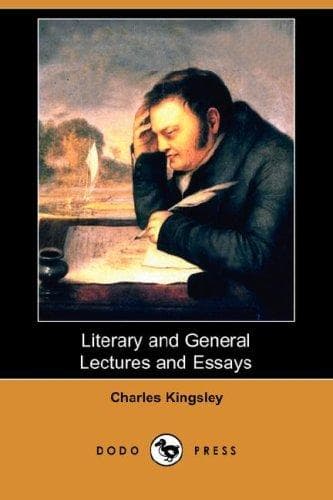
Literary and General Lectures and EssaysKingsley, Charles
History
Literary and General Lectures and Essays
Kingsley, Charles
English literature -- History and criticism
There may be confused words scattered up and down here; there are
still more confused words--not immoral ones--round them, which we
have omitted; but we ask, once and for all, is this true, or is it
not? Is there a being who answers to this description, or is there
not? And if there be, was it not a light price to pay for the
discovery of Him "to sit upon the sacred grass called koos, with his
mind fixed on one object alone; keeping his head, neck, and body
steady, without motion; his eyes fixed upon the point of his nose,
looking at no other place around"--or any other simple, even
childish, practical means of getting rid of the disturbing bustle and
noise of the outward time-world, that he might see the eternal world
which underlies it? What if the discovery be imperfect, the figure
in many features erroneous? Is not the wonder to us, the honour to
him, that the figure should be there at all? Inexplicable to us on
any ground, save that one common to the Bhagavat-Gita, to the gospel.
"He who seeks me shall find me." What if he knew but in part, and
saw through a glass darkly? Was there not an inspired apostle, who
could but say the very same thing of himself, and look forward to a
future life in which he would "know even as he was known"?
It is well worth observing too, that so far from the moral of this
Bhagavat-Gita issuing in mere contemplative Quietism, its purpose is
essentially practical. It arises out of Arjoun's doubt whether he
shall join in the battle which he sees raging below him; it results
in his being commanded to join in it, and fight like a man. We
cannot see, as Mr. Vaughan does, an "unholy indifference" in the
moral. Arjoun shrinks from fighting because friends and relatives
are engaged on both sides, and he dreads hell if he kills one of
them. The answer to his doubt is, after all, the only one which
makes war permissible to a Christian, who looks on all men as his
brothers:
"You are a Ksahtree, a soldier; your duty is to fight. Do your duty,
and leave the consequences of it to him who commanded the duty. You
cannot kill these men's souls any more than they can yours. You can
only kill their mortal bodies; the fate of their souls and yours
depends on their moral state. Kill their bodies, then, if it be your
duty, instead of tormenting yourself with scruples, which are not
really scruples of conscience, only selfish fears of harm to
yourself, and leave their souls to the care of Him who made them, and
knows them, and cares more for them than you do."
This seems to be the plain outcome of the teaching. What is it,
mutatis mutandis, but the sermon "cold-blooded" or not, which every
righteous soldier has to preach to himself, day by day, as long as
his duty commands him to kill his human brothers?
Public-domain text, read in full here on John Shaqi.
Reviews
Reviews
No reviews yet
Be the first to share your thoughts on this work.
Elsewhere in the archive
Join the Discussion
Join the discussion
Sign in to leave a comment or review.
Sign InorCreate an account