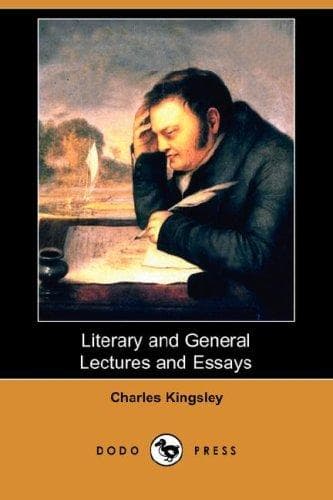
Literary and General Lectures and EssaysKingsley, Charles
History
Literary and General Lectures and Essays
Kingsley, Charles
English literature -- History and criticism
This has been the true reason of mystical isolation in every age and
country. So thought Macarius and the Christian fakeers of the
Thebaid. So thought the medieval monks and nuns. So thought the
German Quietists when they revolted from the fierce degradation of
decaying Lutheranism. So are hundreds thinking now; so may thousands
think ere long. If the individualising phase of Christianity which
is now dominant shall long retain its ascendancy, and the creed of
Dr. Cumming and Mr. Spurgeon become that of the British people, our
purest and noblest spirits will act here, with regard to religion, as
the purest and noblest in America have acted with regard to politics.
They will withdraw each into the sanctuary of his own heart, and
leave the battle-field to rival demagogues. They will do wrong, it
may be. Isolation involves laziness, pride, cowardice; but if sober
England, during the next half-century, should be astonished by an
outburst of Mysticism, as grand in some respects, as fantastic in
others, as that of the thirteenth or the seventeenth centuries, the
blame, if blame there be, will lie with those leaders of the public
conscience who, after having debased alike the Church of England and
the dissenting sects with a selfish individualism which was as
foreign to the old Cromwellite Ironside as to the High Church divine,
have tried to debar their disciples from that peaceful and graceful
Mysticism which is the only excusable or tolerable form, of religion
beginning and ending in self.
Let it be always borne in mind, that Quakerism was not a protest
against, or a revulsion from, the Church of England, but from
Calvinism. The steeple-houses, against which George Fox testified,
were not served by Henry Mores, Cudworths, or Norrises: not even by
dogmatist High-Churchmen, but by Calvinist ministers, who had ejected
them. George Fox developed his own scheme, such as it was, because
the popular Protestantism of his day failed to meet the deepest wants
of his heart; because, as he used to say, it gave him "a dead
Christ," and he required "a living Christ." Doctrines about who
Christ is, he held, are not Christ Himself. Doctrines about what He
has done for man, are not He himself. Fox held, that if Christ be a
living person, He must act (when He acted) directly on the most
inward and central personality of him, George Fox; and his desire was
satisfied by the discovery of the indwelling Logos, or rather by its
re-discovery, after it had fallen into oblivion for centuries.
Whether he were right or wrong, he is a fresh instance of a man's
arriving, alone and unassisted, at the same idea at which Mystics of
all ages and countries have arrived: a fresh corroboration of our
belief, that there must be some reality corresponding to a notion
which has manifested itself so variously, and among so many thousands
of every creed, and has yet arrived, by whatsoever different paths,
at one and the same result.
Public-domain text, read in full here on John Shaqi.
Reviews
Reviews
No reviews yet
Be the first to share your thoughts on this work.
Elsewhere in the archive
Join the Discussion
Join the discussion
Sign in to leave a comment or review.
Sign InorCreate an account