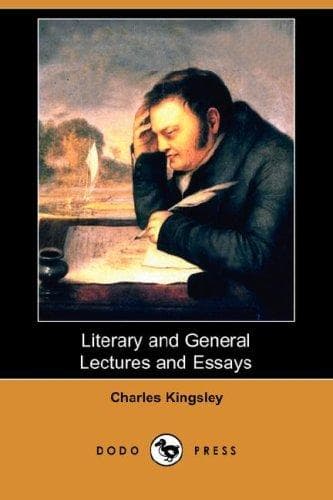
Literary and General Lectures and EssaysKingsley, Charles
History
Literary and General Lectures and Essays
Kingsley, Charles
English literature -- History and criticism
This is unfortunate, perhaps, for the world; for we question whether
a man of talents in anywise to be compared with those of the Ettrick
Shepherd has followed in the footsteps of Burns. Poor Tannahill,
whose sad story is but too well known, perished early, at the age of
thirty-six, leaving behind him a good many pretty love-songs of no
great intrinsic value, if the specimens of them given in Mr.
Whitelaw's collection are to be accepted as the best. Like all
Burns's successors, including even Walter Scott and Hogg, we have but
to compare him with his original to see how altogether unrivalled on
his own ground the Ayrshire farmer was. In one feature only
Tannahill's poems, and those later than him, except where
pedantically archaist, like many of Motherwell's, are an improvement
on Burns: namely, in the more easy and complete interfusion of the
two dialects, the Norse Scotch and the Romanesque English, which
Allan Ramsay attempted in vain to unite; while Burns, though not
succeeding by any means perfectly, welded them together into
something of continuity and harmony--thus doing for the language of
his own country very much what Chaucer did for that of England--a
happy union, in the opinion of those who, as we do, look on the
vernacular Norse Scotch as no barbaric dialect, but as an independent
tongue, possessing a copiousness, melody, terseness, and
picturesqueness which makes it, both in prose and verse, a far better
vehicle than the popular English for many forms of thought.
Public-domain text, read in full here on John Shaqi.
Reviews
Reviews
No reviews yet
Be the first to share your thoughts on this work.
Elsewhere in the archive
Join the Discussion
Join the discussion
Sign in to leave a comment or review.
Sign InorCreate an account