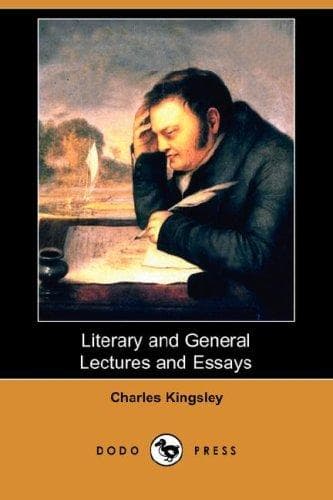
Literary and General Lectures and EssaysKingsley, Charles
History
Literary and General Lectures and Essays
Kingsley, Charles
English literature -- History and criticism
But he must go after all. The editor's den at Leeds is not the place
for lungs bred on Perthshire breezes; and work rises before him,
huger and heavier as he goes on, till he drops under the ever-
increasing load. He will not believe it at first. In sweet
childlike playful letters, he tells his mother that it is nothing.
It has done him good--"opened the grave before his eyes, and taught
him to think of death." "He trusts that he has not borne this, and
suffered, and thought in vain." This too, he hopes, is to be a fresh
lesson-page of experience for his work. Alas! a few months more of
bitter suffering, and of generous kindness and love from all around
him--and it is over with him at the age of twenty-three. Shall we
regret him?--shall we not rather believe that God knew best; and
considering the unhealthy moral atmosphere of the second-class press,
and the strange confused ways into which old ultra-Radicalism,
finding itself too narrow for the new problems of the day, has
stumbled and floundered during the last fifteen years, believe that
he might have been a worse man had he been a longer-lived one, and
thank heaven that "the righteous is taken away from the evil to
come?"
As it is, he ends as he began. The first poem in his book is "The
Ha' Bible;" and the last, written a few days before his death, is
still the death-song of a man--without fear, without repining,
without boasting, blessing and loving the earth which he leaves, yet
with a clear joyful eye upwards and outwards and homewards. And so
ends his little epic, as we called it. May Scotland see many such
another!
The actual poetic value of his verses is not first-rate by any means.
He is far inferior to Burns in range of subject, as he is in humour
and pathos. Indeed, there is very little of these latter qualities
in him anywhere--rather playfulness, flashes of childlike fun, as in
"The Provost," and "Bonnie Bessie Lee." But he has attained a
mastery over English, a simplicity and quiet which Burns never did;
and also, we need not say, a moral purity. His "Poems illustrative
of the Scotch peasantry" are charming throughout--alive and bright
with touches of real humanity, and sympathy with characters
apparently antipodal to his own.
Public-domain text, read in full here on John Shaqi.
Reviews
Reviews
No reviews yet
Be the first to share your thoughts on this work.
Elsewhere in the archive
Join the Discussion
Join the discussion
Sign in to leave a comment or review.
Sign InorCreate an account