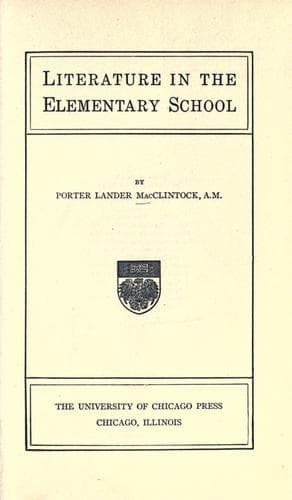
Literature in the Elementary SchoolMacClintock, Porter Lander
General
Literature in the Elementary School
MacClintock, Porter Lander
Literature -- Study and teaching
To identify the reading-lessons of the younger children with their
literature lessons is to keep them at things much too immature, and to
retard their mental and artistic growth. They can apprehend and
appreciate many things that they cannot read. It is a commonplace that a
child's listening vocabulary is far in advance of his reading
vocabulary, no matter how or how early he learns to read. Of course,
this is the secret of the revolt against book-reading of the children
who learn to read late--the simplicity of the thought and expression in
the matter they are mechanically able to read, makes it unacceptable to
them intellectually. It is in the literature received by his ear that a
child grows and exercises his maturer powers. The older children should
be taught and exercised in literary reading, the simple interpretative
reading of their literature. The best results in this most profitable
aspect of the teaching of literature can be obtained in the secondary
period, when the children are expert enough as readers to think while
they read, and when their voices are, as mere mechanical organs, more
completely under control.
The objections to the association of drill in writing, in spelling, in
grammar, and in compositions are of like kind. It may be granted that
there is something in the fact that literature represents the most
effective use of language, and is, all things considered, the most
interesting kind of writing. Still this does not constitute a sufficient
reason why the burden, and in all too many cases the odium, of teaching
these things should attach to literature. It is a perfidious breaking of
the promise of literature, or of any art, which should keep as much as
possible of the atmosphere of play. Of course, drill in language and in
written expression should be attached to every subject in the elementary
curriculum; and this not only for the sake of relieving the literature
from a burden of unattractive tasks, but because of the fact that the
literary style and vocabulary are not good for all subjects and
purposes, and the children should not be trained exclusively in these.
On the large scale of things, it is a pity at any stage of the child's
education to identify "English" with literature, since there is and
should be so much English that is not literature, and so much literature
that is not English.
One of the pleasantest and most profitable co-operations of literature
is with the training in languages other than the vernacular. In those
elementary classes where the children have instruction in either German
or French--or, for the matter of that, in Spanish or Italian--every
effort should be made in their use of story and verse to secure the
characteristic and universal literary effect. The German lyric has all
the beauty of music and of image that the English has; the French
fairy-play has most of elements of dramatic art that the children could
use in English translation.
Public-domain text, read in full here on John Shaqi.
Reviews
Reviews
No reviews yet
Be the first to share your thoughts on this work.
Elsewhere in the archive
Join the Discussion
Join the discussion
Sign in to leave a comment or review.
Sign InorCreate an account