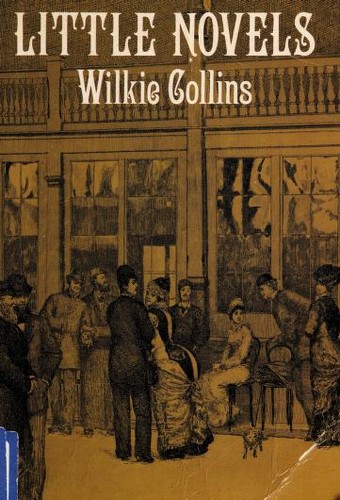
England -- Social life and customs -- 19th century -- Fiction
Take up the Trial again, and look at the circumstances that were
revealed during the investigation in court. His motive for murdering her
is there.
You will see that she did indeed marry him privately; that they lived
together contentedly, until the fatal day when she discovered that his
fancy had been caught by another woman; that violent quarrels took place
between them, from that time to the time when my sermon showed him his
own deadly hatred toward her, reflected in the case of another man; that
she discovered his place of retreat in my house, and threatened him by
letter with the public assertion of her conjugal rights; lastly, that
a man, variously described by different witnesses, was seen leaving the
door of her lodgings on the night of the murder. The Law--advancing no
further than this--may have discovered circumstances of suspicion, but
no certainty. The Law, in default of direct evidence to convict the
prisoner, may have rightly decided in letting him go free.
But _I_ persisted in believing that the man was guilty. _I_ declare that
he, and he alone, was the murderer of Jeromette. And now, you know why.
MISS MINA AND THE GROOM
I.
I HEAR that the "shocking story of my conduct" was widely circulated at
the ball, and that public opinion (among the ladies), in every part of
the room, declared I had disgraced myself. But there was one dissentient
voice in this chorus of general condemnation. You spoke, Madam, with all
the authority of your wide celebrity and your high rank. You said: "I am
personally a stranger to the young lady who is the subject of remark.
If I venture to interfere, it is only to remind you that there are two
sides to every question. May I ask if you have waited to pass sentence,
until you have heard what the person accused has to say in her own
defense?"
These just and generous words produced, if I am correctly informed, a
dead silence. Not one of the women who had condemned me had heard me in
my own defense. Not one of them ventured to answer you.
How I may stand in the opinions of such persons as these, is a matter
of perfect indifference to me. My one anxiety is to show that I am not
quite unworthy of your considerate interference in my favor. Will you
honor me by reading what I have to say for myself in these pages?
I will pass as rapidly as I can over the subject of my family; and
I will abstain (in deference to motives of gratitude and honor) from
mentioning surnames in my narrative.
My father was the second son of an English nobleman. A German lady was
his first wife, and my mother. Left a widower, he married for the second
time; the new wife being of American birth. She took a stepmother's
dislike to me--which, in some degree at least, I must own that I
deserved.
Public-domain text, read in full here on John Shaqi.
Reviews
Reviews
No reviews yet
Be the first to share your thoughts on this work.
Elsewhere in the archive
Join the Discussion
Join the discussion
Sign in to leave a comment or review.
Sign InorCreate an account