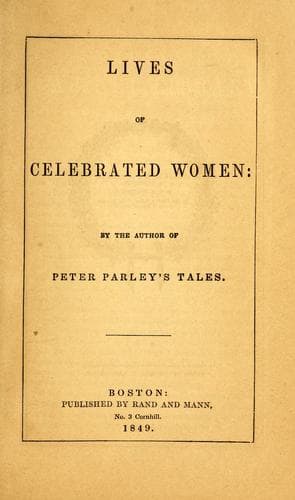
Lives of Celebrated WomenGoodrich, Samuel G. (Samuel Griswold)
History
Lives of Celebrated Women
Goodrich, Samuel G. (Samuel Griswold)
Women -- Biography
Notwithstanding this confidence, Josephine had devoted a portion of
her last day to writing a last farewell to her children. Here are
extracts from it: "My children, your father is dead, and your mother
is about to follow him; but as, before that final stroke, the
assassins leave me a few moments to myself, I wish to employ them in
writing to you. Socrates, when condemned, philosophized with his
disciples; a mother, on the point of undergoing a similar fate, may
discourse with her children. My last sigh will be for you, and I wish
to make my last words a lasting lesson. Time was, when I gave you
lessons in a more pleasing way; but the present will not be the less
useful, that it is given at so serious a moment. I have the weakness
to water it with my tears; I shall soon have the courage to seal it
with my blood. * * * I am about to die as your father died, a victim
of the fury he always opposed, but to which he fell a sacrifice. I
leave life without hatred of France and its assassins; but I am
penetrated with sorrow for the misfortunes of my country. Honor my
memory in sharing my sentiments. I leave for your inheritance the
glory of your father, and the name of your mother, whom some who have
been unfortunate will bear in remembrance." In more prosperous days,
the poor and the distressed had ever found Josephine's heart and hand
open for their relief. She was now herself obliged to rely upon the
benevolence of others for her own subsistence, and of the services she
then received, she ever retained a grateful recollection. She had been
most affected by the attentions of Madame Dumoulin, and felt great
delight, in after years, in adverting to the subject. At this period
of general scarcity, this benevolent lady every day entertained at her
table a party of those whose means were more limited. Madame de
Beauharnais was a regular guest. Bread was at this time so scarce as
to be a subject of legal enactment, restricting the quantity allowed
to each person to two ounces. Guests at the houses of the most
opulent, even, were expected to bring their own bread. Aware that
Madame de Beauharnais was in more distressed circumstances than the
rest, Madame Dumoulin dispensed with this practice in her favor,
thereby justifying the expression of the latter, that she received
_her daily bread_ from her.
Public-domain text, read in full here on John Shaqi.
Reviews
Reviews
No reviews yet
Be the first to share your thoughts on this work.
Elsewhere in the archive
Join the Discussion
Join the discussion
Sign in to leave a comment or review.
Sign InorCreate an account