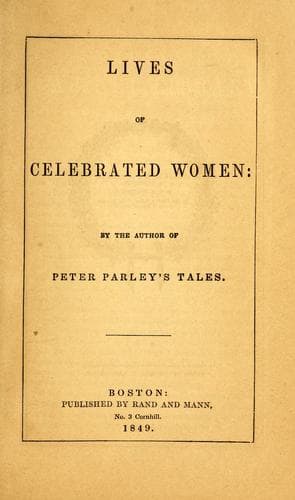
Lives of Celebrated WomenGoodrich, Samuel G. (Samuel Griswold)
History
Lives of Celebrated Women
Goodrich, Samuel G. (Samuel Griswold)
Women -- Biography
When her husband told her that he was condemned to the scaffold, she
congratulated him upon the speedy termination of an existence so
painful, and the unperishing reward that should crown it. Before the
Revolutionary Tribunal she was unabashed, and, when accused of a
horrid crime, she put her traducers to shame by exclaiming, "I appeal
to every mother here whether such an act be possible!" In solitude,
and in the depths of a damp and loathsome dungeon, where she was
confined for weeks, she was still serene and uncomplaining. In parting
with her son; in taking a last adieu of the palace which had witnessed
her triumphs; in facing the scaffold, and the wretches around it; and
in bidding a final farewell to life,--Marie Antoinette evinced that
patient, deep, and touching heroism which a woman and a Christian
alone can display.
MADAME ROLAND.
When, in May, 1793, Robespierre and the Mountain effected the final
overthrow of the Girondists--the moderate party of the French
revolutionists--M. Roland, who had recently resigned his office in the
ministry, was forced to flee, and his wife was thrown into prison. To
solace the sad hours of her captivity, she began to write her own
Memoirs. "I propose to myself," she says, "to employ the leisure hours
of my captivity in relating the history of my life, from my infancy to
the present time. Thus to retrace the steps of one's career is to live
a second time; and what better can a prisoner do than, by a happy
fiction, or by interesting recollections, to transport herself from
her prison?"
Her Memoirs are dated at the "Prison of St. Pelagie, August 9th,
1793," and she thus commences: "Daughter of an artist, wife of a
philosopher, who, when a minister of state, remained a man of virtue;
now a prisoner, destined, perhaps, to a violent and unexpected
death,--I have known happiness and adversity; I have learned what
glory is, and have suffered injustice. Born in an humble condition,
but of respectable parents, I passed my youth in the bosom of the
arts, and amidst the delights of study; knowing no superiority but
that of merit, no grandeur but that of virtue."
Her father, Gratien Philipon, was an engraver. During the early years
of Manon's life, he was well off, employing many workmen under him.
His wife possessed little of what is called knowledge, but she had a
discerning judgment and a gentle and affectionate disposition. By her
example, as well as by the course of education which her disposition
led her to pursue, she formed in her daughter the same gentle,
feminine spirit which she herself possessed.
Public-domain text, read in full here on John Shaqi.
Reviews
Reviews
No reviews yet
Be the first to share your thoughts on this work.
Elsewhere in the archive
Join the Discussion
Join the discussion
Sign in to leave a comment or review.
Sign InorCreate an account