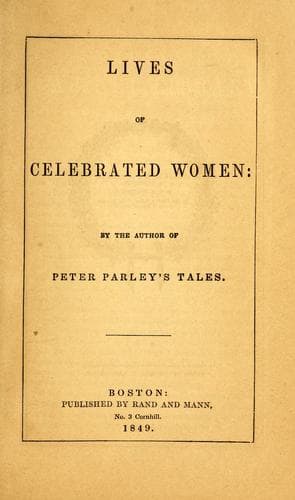
Lives of Celebrated WomenGoodrich, Samuel G. (Samuel Griswold)
History
Lives of Celebrated Women
Goodrich, Samuel G. (Samuel Griswold)
Women -- Biography
The daughter of a prosperous tradesman, she had many suitors of her
own rank; but she had formed to herself a _beau ideal_ of wedded life
which none but a man of education could satisfy; they were all
rejected. A physician proposed; more refinement and knowledge was to
be expected in the learned professions; she hesitated, but he also was
rejected. In the mean time, her father's habits began to change; he
became a speculator, fond of pleasure and careless of his business.
His speculations failed, and his customers left him. Her mother
witnessed the approach of poverty with anxiety; she feared for her
daughter alone, for her own health was so feeble, that she could look
only for a short term of life. She wished to see her daughter's
happiness made as secure as possible, and tried to persuade her to
accept the addresses of a young jeweller who had health and a good
character to recommend him; but Manon wished to find in her husband a
companion and a guide.
Her mother died; and intense grief overwhelmed the daughter, both body
and mind. It was long before she could be roused to any exertion from
that melancholy "which made her a burden to herself and others." At
this moment, the "Nouvelle Heloise" was placed in her hands; it
excited her attention, and called her thoughts from her loss. "I was
twenty-one," she says, "and Rousseau made the same impression on me as
Plutarch had done when I was eight. Plutarch had disposed me to
republicanism; he had awakened the energy and pride which are its
characteristics; he inspired me with a true enthusiasm for public
virtue and freedom. Rousseau showed me domestic happiness, and the
ineffable felicity I was capable of tasting." She now returned to her
studies. Her friends, among whom she numbered some literary men,
finding that she committed her reflections to writing, predicted that
she would become an author. But she was not ambitious of public
distinction; she had adopted the sentiment of Rousseau, that the
"dignity of woman is in being unknown; her glory, in the esteem of her
husband; her pleasures, in the happiness of her family." "I saw," says
Madame Roland, "that an authoress loses more than she gains. My chief
object was my own happiness, and I never knew the public interfere
with that for any one without spoiling it; there is nothing more
delightful than to be appreciated by those with whom one lives, and
nothing so empty as the admiration of those whom we are never to
meet."
Public-domain text, read in full here on John Shaqi.
Reviews
Reviews
No reviews yet
Be the first to share your thoughts on this work.
Elsewhere in the archive
Join the Discussion
Join the discussion
Sign in to leave a comment or review.
Sign InorCreate an account