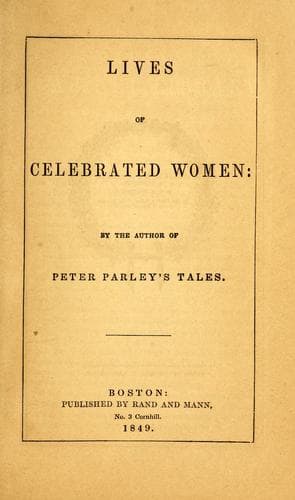
Lives of Celebrated WomenGoodrich, Samuel G. (Samuel Griswold)
History
Lives of Celebrated Women
Goodrich, Samuel G. (Samuel Griswold)
Women -- Biography
Most men would have shrunk from the task of personally superintending
the education of a young girl, and would, in conformity to the
customs of the times, have consigned her to a convent, where she
would have been taught to read, to write, to dance, and to
embroider; and then her education would have been deemed complete.
It is no slight evidence of the good sense of her uncle that he
retained her in his own house. The decision was a fortunate one for
posterity; for her faculties, which the formal training of the
convent would have cramped, were called into exercise and expanded
by an unusual indulgence in the range of reading, and probably by a
familiar intercourse with the men of letters who sought her uncle's
society. Under his instructions she doubtless acquired a knowledge
of the Latin and Italian languages, and something of the Spanish.
All this, however, is to some extent matter of inference, for we
have no record of her early life. She tells us in her "Letters" that
she was brought up at court, and there she formed her manners and
her tastes--fortunately without the corruption of her morals.
From the accounts given by her witty and profligate cousin Bussy-Robertin,
we can obtain a tolerably correct idea of her appearance when she entered
as an actor upon the scene of life. She was somewhat tall for a woman; had
a good shape, a pleasing voice, a fine complexion, brilliant eyes, and a
profusion of light hair; but her eyes, though brilliant, were small,
and, together with the eyelashes, were of different tints: her lips,
though well colored, were too flat, and the end of her nose too
square. De Bussy tells us that she had more shape than grace, yet
danced well; she had also a taste for singing. He makes to her the
objection that she was too playful "for a woman of quality."
Not beautiful, but highly attractive, of cordial manners, and with a
lively sensibility, at one moment dissolved in tears, and at another
almost dying with laughter,--Mademoiselle de Robertin, then eighteen
years old, was married to the Marquis de Sevigne, of an ancient family
of Brittany. Her letters written during the first years of her
marriage are full of gayety; there is no trace of misfortune or
sorrow. But her husband was fond of pleasure, extravagant in his
expenses, heedless, and gay--a character not likely to escape the
contagion of that universal depravity of manners which prevailed at
the French court. His conduct threw a cloud over their happiness.
Madame de Sevigne bore her misfortunes with dignity and patience. In
spite of his misconduct, she loved him deeply; and his death, not long
afterwards, in a duel, caused her the most profound sorrow.
Public-domain text, read in full here on John Shaqi.
Reviews
Reviews
No reviews yet
Be the first to share your thoughts on this work.
Elsewhere in the archive
Join the Discussion
Join the discussion
Sign in to leave a comment or review.
Sign InorCreate an account