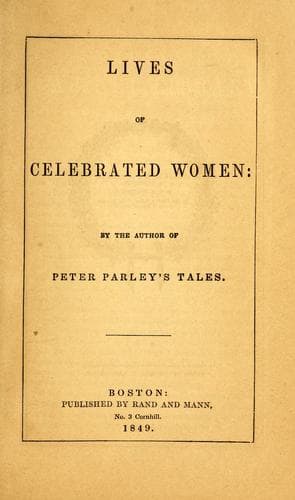
Lives of Celebrated WomenGoodrich, Samuel G. (Samuel Griswold)
History
Lives of Celebrated Women
Goodrich, Samuel G. (Samuel Griswold)
Women -- Biography
Tested by the morality of our day, Madame de Sevigne could not claim a
very exalted character: yet we are bound to mention one trait, which
honorably distinguishes her from her contemporaries. Louis XIV., for
the purpose of reducing the power of his nobles, systematically
encouraged them in the most boundless extravagance, of which he
himself set them the example. The natural consequence followed; they
became inextricably involved in debts, with so little idea of ever
paying them, that the conduct of the Cardinal de Retz, who sought to
atone for early excesses by retiring to the country, and husbanding
his resources for this purpose, excited universal wonder, and was too
extraordinary to be generally credited. Madame de Sevigne fully
appreciated the propriety of this conduct of De Retz, and bestows upon
it many commendations. When such were the sentiments of her mother, it
is not a little surprising to hear of a poor milliner, whose
necessities compelled her to undertake a journey of five hundred
miles, from Paris to Provence, to collect a debt from Madame de
Grignan, being dismissed without her money, and being told in
substance, if not in words, that she might thank her good fortune that
she did not make her exit through the window--a summary mode of
cancelling debts, often threatened, if not executed, when creditors
were importunate. Nor were Madame de Sevigne's mere professions. The
occasion arose which tried her principles. The extravagance of her
husband left her with estates encumbered with debts; the education
and maintenance of her children were expensive; her son's commission
in the army was purchased at a high price; her rents were not paid
with punctuality, and she was obliged to remit large debts to her
tenants. From all these causes, she found herself, at the age of
fifty-eight, involved in debts, which nothing but a retirement from
Paris, and the practice of a rigid economy, would enable her to pay.
She did not hesitate to withdraw herself from her beloved society in
Paris, and to retire to "The Rocks." The sacrifice was rendered more
complete by the fact that her daughter was at that time residing at
Paris. Her absence was felt bitterly by her friends, and she was at
once mortified and gratified by the offer of a loan of money to
facilitate her return. Madame de la Fayette wrote to make her the
proposition: "You must not, my dear, at any price whatever, pass the
winter in Brittany. You are old; 'The Rocks' are thickly wooded; colds
will destroy you; you will get weary; your mind will become sad, and
lose its tone: this is certain; and all the business in the world is
nothing in comparison. Do not speak of money nor of debts;" and then
follows the proposal. Madame de Sevigne declined the offer, being
unwilling to incur the obligation. Conceived with all possible
kindness, there was a sting in the letter which Madame de Sevigne
confesses to her daughter, that she felt. "You were, then, struck by
Public-domain text, read in full here on John Shaqi.
Reviews
Reviews
No reviews yet
Be the first to share your thoughts on this work.
Elsewhere in the archive
Join the Discussion
Join the discussion
Sign in to leave a comment or review.
Sign InorCreate an account