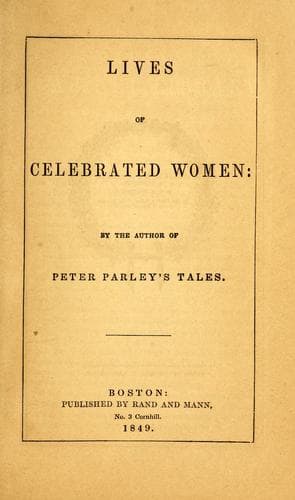
Lives of Celebrated WomenGoodrich, Samuel G. (Samuel Griswold)
History
Lives of Celebrated Women
Goodrich, Samuel G. (Samuel Griswold)
Women -- Biography
Her only daughter, Anne Louisa Germaine, born in 1766, became her next
object of solicitude. She wished that her education should be perfect;
she wished her to know every thing, and thought that her mind could
not be stored with too many words and facts; she introduced her, even
in infancy, to the brilliant circle of her own friends, and learned
men were almost her only companions. It was therefore with a transport
of delight that the child received, at the age of eleven, a young
girl, whom her mother wished her to make her companion, and who
afterwards described her thus: "She spoke with a warmth and facility
which were already eloquent, and which made a great impression on me.
We did not play like children. She at once asked me what my lessons
were, if I knew any foreign languages, and if I went often to the
play. When I said, I had only been three or four times, she exclaimed,
and promised that we should often go together, and, when we came home,
write down an account of the piece. It was her habit, she said; and,
in short, we were to write to each other every day. We entered the
drawing-room. Near the arm-chair of Madame Necker was the stool of her
daughter, who was obliged to sit very upright. As soon as she had
taken her accustomed place, three or four old gentlemen came up, and
spoke to her with the utmost kindness. One of them, in a little round
wig, took her hands in his, held them a long time, and entered into
conversation with her, as if she had been twenty. This was the Abbe
Raynal; the others were Messrs. Marmontel, Thomas, the Marquis de
Pesay, and Baron de Grimm. We sat down at table. It was a picture to
see how Mademoiselle Necker listened. She did not speak herself; but
so animated was her face, that she appeared to converse with all. Her
eyes followed the looks and movements of those who talked; it seemed
as if she grasped their ideas before they were expressed. She entered
into every subject, even politics, which at this epoch was one of the
most engrossing topics. After dinner, a good deal of company arrived.
Each guest, as he approached Madame Necker, addressed her daughter
with some compliment or pleasantry; she replied to all with ease and
grace. They delighted to attack and embarrass her, and to excite her
childish imagination, which was already brilliant. The cleverest men
were those who took the greatest pleasure in making her talk." When
she was not in society, she was kept constantly at her books. She
wrote a great deal, and her writings were read in public and
applauded. This system of education had its natural results. Praise,
and reputation, and success in society, became as necessary to her as
her daily food: her understanding, brilliant, but not profound,
gathered knowledge by cursory reading and from conversation--not by
hard study; hence it was superficial.
Public-domain text, read in full here on John Shaqi.
Reviews
Reviews
No reviews yet
Be the first to share your thoughts on this work.
Elsewhere in the archive
Join the Discussion
Join the discussion
Sign in to leave a comment or review.
Sign InorCreate an account