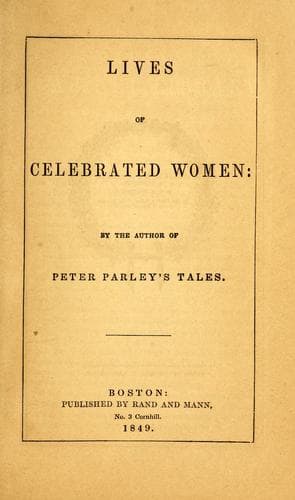
Lives of Celebrated WomenGoodrich, Samuel G. (Samuel Griswold)
History
Lives of Celebrated Women
Goodrich, Samuel G. (Samuel Griswold)
Women -- Biography
The position which her father held in France, during her early years,
exercised a very important influence on the character and feelings of
Mademoiselle Necker. Despised as a plebeian and detested as a reformer
by the queen and the court, he was regarded, by the moderate of all
parties, as the only man who could save France, and was worshipped as
an idol by the people at large. No sooner was it known that he had
resigned, than "all France," as she says,--that is, all who were
eminent for wealth, for talent, or for rank, excepting the few
attached to the court,--came to visit him, and to express to him their
regrets, their fears, and the hope that he would soon return to
office. She heard that consternation pervaded Paris; all fearing ruin
for that country which Necker had abandoned. It is not surprising that
she should conceive for him a passionate admiration; should regard him
as superior to all in modern times, and as answering the _beau ideal_
of Grecian or of Roman patriotism. Nor is it wonderful that his
persecution by the court should have excited feelings of resentment
and disgust towards a form of government under which such things could
take place.
Necker remained a short time in France, and then returned to Coppet,
an estate which he purchased on the banks of the Lake of Geneva, from
whence he watched the course of events, feeling certain that he should
at last be recalled to the helm. An occasional visit to Paris, or the
publication of a political pamphlet, served to keep him in the public
remembrance.
At the age of twenty-two; Mademoiselle Necker was married. To her,
marriage was merely a convenience. It was necessary to give her a
position in society--admittance at court. She did not look for a
lover, not even for a friend or companion, in her husband. He must be
of noble birth, and a Protestant. The Baron de Stael, the Swedish
ambassador, had both these requisites; he was, moreover, an amiable
and honorable man. He had received positive assurances from his
sovereign, that he should be continued for many years at the court of
France, and she, having made a distinct contract that she should never
be obliged to go to Sweden, except with her own consent, accepted his
proposals of marriage.
Public-domain text, read in full here on John Shaqi.
Reviews
Reviews
No reviews yet
Be the first to share your thoughts on this work.
Elsewhere in the archive
Join the Discussion
Join the discussion
Sign in to leave a comment or review.
Sign InorCreate an account