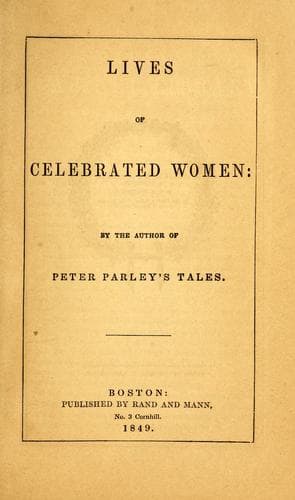
Lives of Celebrated WomenGoodrich, Samuel G. (Samuel Griswold)
History
Lives of Celebrated Women
Goodrich, Samuel G. (Samuel Griswold)
Women -- Biography
His name revived the public credit; the pressing wants of the treasury
were supplied; by importing grain, he removed the fears of famine. His
position at this period was one to gratify his highest ambition; his
return had been a triumph over the court; and the people were eager to
prostrate themselves at his feet. But his talents were those of the
financier only; as a statesman, he was sadly wanting. The example of
the Americans had excited in the minds of a portion of the nobility an
indefinable and romantic longing for something called _liberty_; the
middle classes, who possessed the most intelligence, education, and
wealth, were indignant at being excluded from most places of honor,
and at being obliged to bear the whole burden of the taxes, from which
the nobles and the clergy were exempt; the great body of the people,
who were in the condition of slaves, had the wrongs and outrages of
many centuries of oppression to avenge: all these classes, though
agreeing in nothing else, were united in demanding a change. On the
other side, the queen, supported by her royal brothers-in-law and a
portion of the nobles, resolutely set themselves against any
innovations.
Necker did not agree entirely with either party; he was in favor of a
limited monarchy; the British constitution appeared to him, as it did
to his daughter, the perfection of government. But he had not the
decision and energy requisite for insuring the success of his own
opinions. The well-disposed but weak monarch yielded to the more
daring counsels of the court, and prepared to crush at once their
opponents by force. But these measures were concerted without the
knowledge of Necker, and before they could be executed, he must
quietly be got rid of. Accordingly, on the 11th of July, 1789, as he
was about to sit down to dinner, he received an order to quit France
within four and twenty hours, and without exciting observation. Necker
obeyed to the very letter. He and his wife, without changing their
dress, stepped into the carriage, as if to take the usual evening
airing, and travelled night and day till they reached Brussels.
Madame de Stael was informed of this event on the morning of the 12th,
and on the 15th, having been advised of their route, she set off to
join her parents. "When I reached them," says she, "three days after,
they still wore the full dress which they had on, when, after a large
dinner party, and while no one suspected the agitating position in
which they were placed, they silently quitted France, their friends,
their home, and the power which they enjoyed. This dress, covered with
dust, the name assumed by my father for the sake of avoiding
recognition in France, and so detention through the favor in which he
was still held,--all these filled me with feelings of reverence, that
caused me to throw myself at his feet, as I entered the room of the
inn where I found him."
Public-domain text, read in full here on John Shaqi.
Reviews
Reviews
No reviews yet
Be the first to share your thoughts on this work.
Elsewhere in the archive
Join the Discussion
Join the discussion
Sign in to leave a comment or review.
Sign InorCreate an account