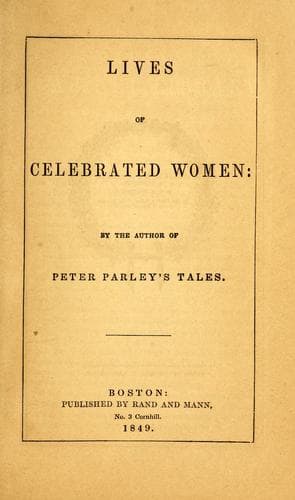
Lives of Celebrated WomenGoodrich, Samuel G. (Samuel Griswold)
History
Lives of Celebrated Women
Goodrich, Samuel G. (Samuel Griswold)
Women -- Biography
She submitted her book to the censor, and expunged such passages as
were objected to. She now deemed herself safe in publishing it. Ten
thousand copies were already printed, when an order was issued by
Savary, minister of police, for the suppression of the work. The
impressions were seized, and, the ink being obliterated by a chemical
process, the paper was returned to the publisher. The manuscript was
demanded, and the author ordered to quit France in twenty-four hours;
but, upon her remonstrance, the time was extended to eight days. "Your
exile," says Savary, "is the natural consequence of the course of
conduct you have constantly pursued for many years. It is evident that
the air of France does not agree with you." The true reasons for the
suppression of her work were not assigned, but were turned off with
the remark that "It is not French; and that the French are not yet
reduced to seek for models in the countries which she admired."
In 1810, M. de Rocca, a French officer, who was yet suffering from
dangerous wounds, received in Spain, arrived at Geneva. His personal
condition and his reputation for brilliant courage heightened the
interest excited by his youth and noble physiognomy. He first saw
Madame de Stael at a public assembly. She entered the ball-room,
dressed in a costly but unbecoming style, and followed by a train of
admirers. "Is this the far-famed woman?" said Rocca; "she is very
ugly, and I detest such straining for effect." A few words of
sympathy, set off by the music of her voice, effected a complete
revolution in his feelings. Wishes and hopes apparently the most
extravagant took possession of his heart--for she was now a widow. "I
will love her so much that she will marry me," said he, and his words
were soon fulfilled; but the event was carefully concealed until the
death of Madame de Stael; for she was peculiarly sensitive to public
opinion, and refused to acknowledge a marriage which might have
excited ridicule--so great was the disparity of age and of condition
between the parties. She was unwilling likewise to change her name.
"Mon nom est a l'Europe," said she to M. Rocca, when, on a subsequent
occasion, he jestingly asked her to marry him.
Public-domain text, read in full here on John Shaqi.
Reviews
Reviews
No reviews yet
Be the first to share your thoughts on this work.
Elsewhere in the archive
Join the Discussion
Join the discussion
Sign in to leave a comment or review.
Sign InorCreate an account