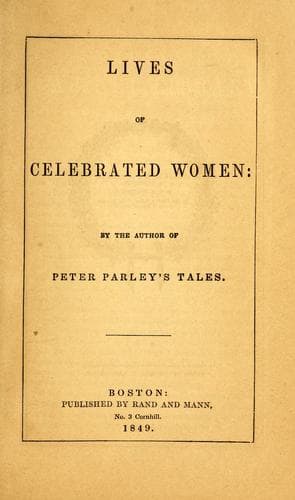
Lives of Celebrated WomenGoodrich, Samuel G. (Samuel Griswold)
History
Lives of Celebrated Women
Goodrich, Samuel G. (Samuel Griswold)
Women -- Biography
The chief works of Madame de Stael, and her peculiarities as an
author, have already been spoken of. One work, published after her
death, and the most powerful of all, remains to be mentioned. In the
"Considerations on the French Revolution," she sought to blend the
memoir with the philosophical history. The faults are what might have
been expected. The details, too minute for the one, are too scanty for
the other. In the selection of these she was biased by her personal
feelings, but to a degree far less than was to be anticipated. Her
feelings were warm and excitable; she had lived in the midst of the
events of which she speaks; she had herself been an actor, and her
father had borne a conspicuous part, in them; indeed, one grand
purpose of the work is to exculpate him. That she should, under these
disqualifying circumstances, have produced a work so temperate, and on
the whole so impartial--one that exhibits such philosophical depth and
comprehensiveness of vision--excites in us wonder and admiration. But
it is not as a history that the work is interesting and valuable. It
is that it exhibits to us the impressions made by the great events of
which she speaks, and the scenes which she witnessed, upon a powerful
and original mind. It abounds with profound reflections and brilliant
remarks. The style, eloquent and impassioned, is in a high degree
conversational, and, as we read it, we almost expect to hear the sound
of the voice. The remarkable talent for discrimination and delineation
of character, which distinguish her as a novelist, lead us to regret
that it did not come within the design of the work to furnish us with
historical portraitures of the distinguished personages of the period.
The few which she has given us, increase our regret, and mark her as a
mistress in the art.
LADY HESTER STANHOPE.
The third Earl of Stanhope, father of the subject of our present
sketch, possessed abilities which qualified him for any station; yet
he devoted his ample fortune, his time, and his thoughts, to mechanics
and to experiments in science and philosophy; with what success, the
Stanhope printing press, many improvements in the process of
stereotype printing, and his various papers on the electric fluid, are
evidence. He married a daughter of the great Earl of Chatham; and of
this marriage, Lady Hester Stanhope was the earliest fruit. She was
born in 1776.
[Illustration: LADY HESTER STANHOPE.]
Public-domain text, read in full here on John Shaqi.
Reviews
Reviews
No reviews yet
Be the first to share your thoughts on this work.
Elsewhere in the archive
Join the Discussion
Join the discussion
Sign in to leave a comment or review.
Sign InorCreate an account