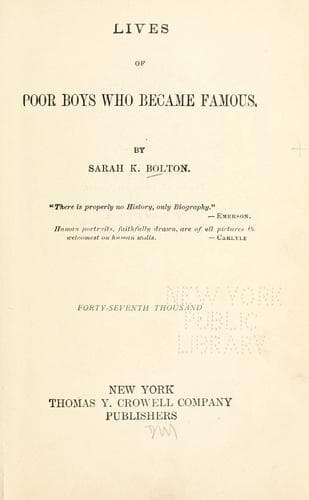
Lives of Poor Boys Who Became FamousBolton, Sarah Knowles
History
Lives of Poor Boys Who Became Famous
Bolton, Sarah Knowles
Biography
After a short vacation with his mother, he went back to Leipzig. The
second volume of the "Greenland Lawsuits" was now published, and for
this he received one hundred and twenty-six dollars,--nearly twice that
given for the first volume. This did not take with the public, and the
third volume was refused by every publisher. His money was gone. What
could he do? He would try, as some other authors had done, the plan of
writing letters to distinguished people, telling them his needs. He did
so, but received no answers. Then, spurred on by necessity, he took the
manuscript in his hand, and presented it himself at the doors of the
learned; but he was either not listened to, or repulsed on every
occasion. How one pities this lad of nineteen! How many wealthy men
might have aided him, but they did not! He wrote a few essays for
various periodicals, but these brought little money, and were seldom
wanted. His high hopes for a literary career began to vanish.
It was evident that he must give up college life, for he could not get
enough to eat. He had long discontinued his evening meal, making his
supper of a few dried prunes. His boarding-mistress was asking daily for
her dues. He could bear the privation and the disgrace no longer, and,
packing his satchel, and borrowing a coat from a college boy, that he
might not freeze, he stole away from Leipzig in the darkness of the
twilight, and went home to his disconsolate mother. Is it any wonder
that the poor are disconsolate? Is it any wonder that they regard the
wealthy as usually cold and indifferent to their welfare? Alas! that so
many of us have no wish to be our "brother's keeper."
Perhaps some of the professors and students wondered where the bright
lad had gone; but the world forgets easily. Frau Richter received her
college boy with a warm heart, but an empty purse. She was living with
her two children in one room, supporting them as best she could by
spinning, working far into the night. In this room, where cooking,
washing, cleaning, and spinning were all carried on, Paul placed his
little desk and began to write. Was the confusion trying to his
thoughts? Ah! necessity knows no law. He says, "I was like a prisoner,
without the prisoner's fare of bread and water, for I had only the
latter; and if a gulden found its way into the house, the jubilee was
such that the windows were nearly broken with joy." But with the
strength of a noble and heroic nature, he adds, "What is poverty that a
man should whine under it? It is but like the pain of piercing the ears
of a maiden, and you hang precious jewels in the wound."
The family were so needy, however, that they must look somewhere for
aid, and hesitatingly Paul applied to Vogel, the young pastor, who
loaned them twenty-five gulden. Very soon the boarding-mistress from
Leipzig appeared, having walked the whole way to Hof, and demanded her
pay. In his distress Paul sent her to another friend, Otto, who became
surety for the debt.
Public-domain text, read in full here on John Shaqi.
Reviews
Reviews
No reviews yet
Be the first to share your thoughts on this work.
Elsewhere in the archive
Join the Discussion
Join the discussion
Sign in to leave a comment or review.
Sign InorCreate an account