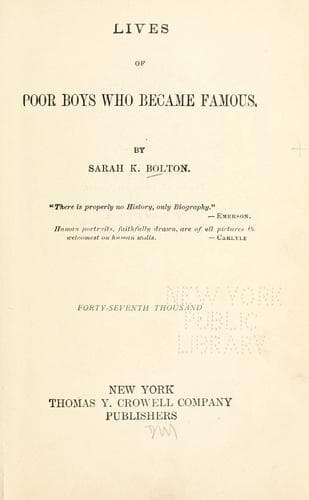
Lives of Poor Boys Who Became FamousBolton, Sarah Knowles
History
Lives of Poor Boys Who Became Famous
Bolton, Sarah Knowles
Biography
Farragut was now nearly forty years of age; never pushing himself
forward, honors had come slowly. Three years later, having been made
commandant, he married Miss Virginia Royall, also of Norfolk, Va. At the
beginning of the Mexican War, he offered his services to the Government,
but from indifference, or the jealousy of officials, he was not called
upon. The next twelve years were spent, partly in the Norfolk Navy Yard,
giving weekly lectures on gunnery, preparing a book on ordnance
regulations, and establishing a navy yard on the Pacific Coast. Whatever
he did was done thoroughly and faithfully. When asked by the Navy
Department to express a preference about a position, he said, "I have no
volition in the matter; your duty is to give me orders, mine to obey....
I have made it the rule of my life to ask no official favors, but to
await orders and then obey them."
And now came the turning-point of his life. April 17, 1860, Virginia, by
a vote of eighty-eight to fifty-five, seceded from the United States.
The next morning, Farragut, then at Norfolk, expressed disapproval of
the acts of the convention, and said President Lincoln would be
justified in calling for troops after the Southerners had taken forts
and arsenals. He was soon informed "that a person with those sentiments
could not live in Norfolk."
"Well then, I can live somewhere else," was the calm reply.
Returning home, he announced to his wife that he had determined to
"stick to the flag."
"This act of mine may cause years of separation from your family; so you
must decide quickly whether you will go North or remain here."
She decided at once to go with him, and, hastily collecting a few
articles, departed that evening for Baltimore. That city was in
commotion, the Massachusetts troops having had a conflict with the mob.
He finally secured passage for New York on a canal-boat, and with
limited means rented a cottage at Hastings-on-the-Hudson, for one
hundred and fifty dollars a year. He loved the South, and said, "God
forbid that I should have to raise my hand against her"; but he was
anxious to take part in the war for the Union, and offered his services
to that end.
Public-domain text, read in full here on John Shaqi.
Reviews
Reviews
No reviews yet
Be the first to share your thoughts on this work.
Elsewhere in the archive
Join the Discussion
Join the discussion
Sign in to leave a comment or review.
Sign InorCreate an account