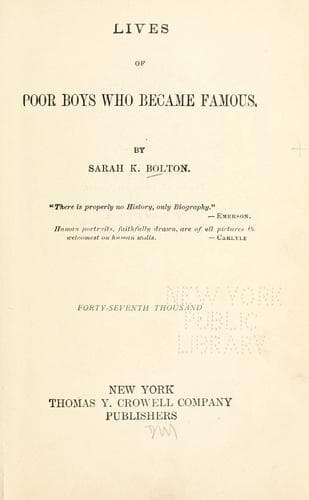
Lives of Poor Boys Who Became FamousBolton, Sarah Knowles
History
Lives of Poor Boys Who Became Famous
Bolton, Sarah Knowles
Biography
The next year, in command of the European squadron, accompanied by Mrs.
Farragut, who went by special permission of the President, he visited
France, Russia, and other countries.
Napoleon III. welcomed him to the Tuileries; the Grand Duke Constantine
of Russia, Duke of Edinburgh, and Victor Emmanuel each made him their
guest; he dined with the King of Denmark and the King of Greece, and
Queen Victoria received him at the Osborne House. Two years later he
visited the navy yard on the Pacific Coast, which he had established
years before.
He died Aug. 14, 1870, at the age of sixty-nine, universally honored and
regretted. Congress appropriated twenty thousand dollars for his statue
on Farragut Square, Washington, and the work has been executed by Vinnie
Ream Hoxie.
Success was not an accident with the Christian admiral. It was the
result of devotion to duty, real bravery, and a life distinguished by
purity of character and the highest sense of honor.
EZRA CORNELL.
In the winter of 1819 might have been seen travelling from New Jersey to
De Ruyter in New York, a distance of two hundred and fifty miles, some
covered emigrant wagons, containing a wife and six children in the
first, and household goods and farming utensils in the others. Sometimes
the occupants slept in a farmhouse, but usually in their vehicles by a
camp-fire in the woods.
For two weeks they journeyed, sometimes through an almost uninhabited
wilderness and over wellnigh impassable roads. The mother, with a baby
in her arms,--her oldest child, Ezra, a boy of twelve,--must have been
worn with this toilsome journey; but patient and cheerful, no word of
repining escaped her lips. Elijah Cornell, a frank, noble-hearted
Quaker, was going West to make his living as a potter and farmer
combined.
Like other pioneers, they made ready their little home among the sterile
hills; and there, for twenty years, they struggled to rear a family that
grew to eleven children, instead of six. The boys of the family were
taught the simple mysteries of pottery-making early in life, and thus
formed habits of industry, while their limited income necessarily made
them economical.
[Illustration: EZRA CORNELL.
(From his Biography, by Gov. A. B. Cornell.)]
The eldest boy, Ezra,--now sixteen,--was growing anxious to be something
more than a potter. He was nearly six feet tall, thin, muscular, and
full of energy. He was studious, reading every book within his reach,
and desirous of an education, which there was no money to procure.
Determined, if possible, to go to the common school one more winter, he
and his brother, fifteen years of age, chopped and cleared four acres of
heavy beech and maple woodland, plowed, and planted it to corn, and thus
made themselves able to finish their education.
Public-domain text, read in full here on John Shaqi.
Reviews
Reviews
No reviews yet
Be the first to share your thoughts on this work.
Elsewhere in the archive
Join the Discussion
Join the discussion
Sign in to leave a comment or review.
Sign InorCreate an account